
How to Actually Feel Safe at Night When You Live Alone
Living alone and can’t sleep through the night? Here’s what actually works — a 5-minute lockdown routine, cheap door fixes, and the mental tricks for when your brain won’t quiet down.
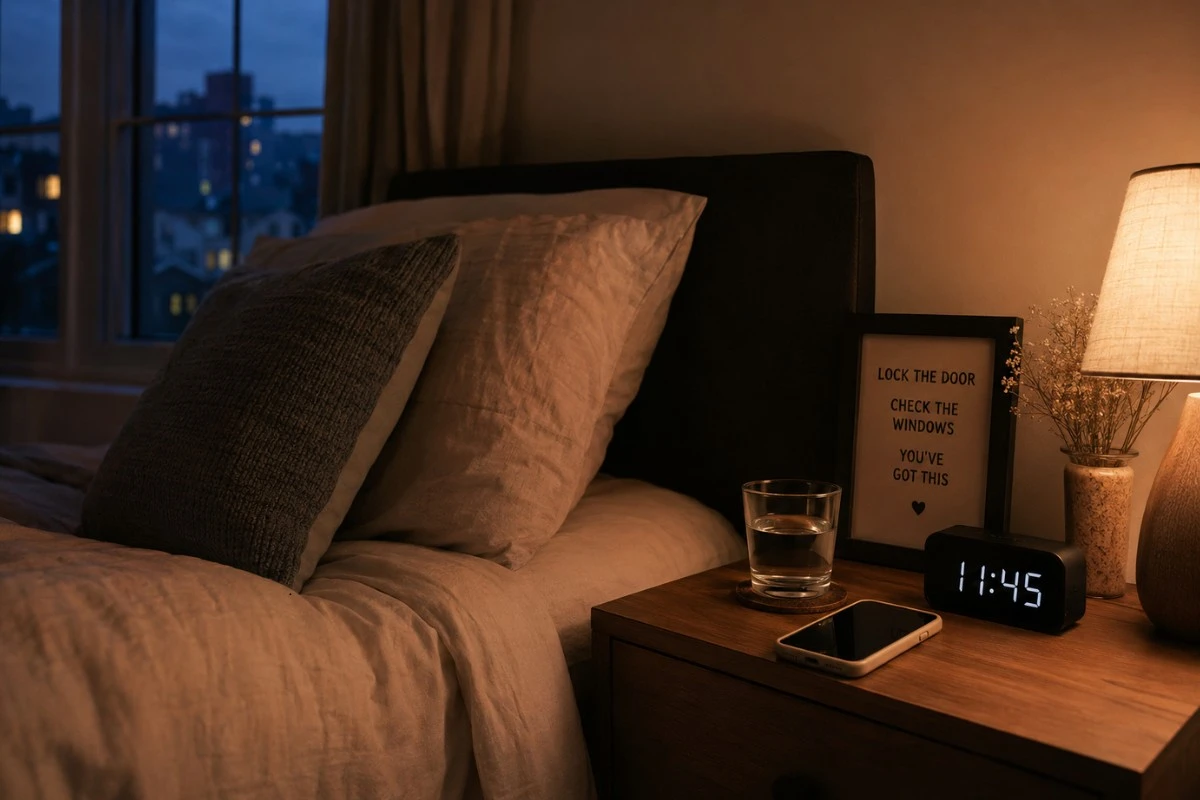
It’s almost midnight. You’re in bed. The building made a sound, and now you’re wide awake, listening.
Yeah. I know that feeling.
I’ve lived alone for seven years. The first year was rough. I slept with every light on. I had a kitchen knife under my pillow for like four months. Looking back, it’s kind of funny, but at the time, I was just scared every single night.
What changed wasn’t that I got braver. I just figured out a few things that actually worked. Some of them are physical, like the door stuff and the windows. Some of them are mental. Most of them are small and cheap, and nobody really talks about them.
This guide is all of it. The stuff I do every night before bed. The cheap fixes that made my apartment feel solid instead of flimsy. The tricks for when everything is locked, and your brain still won’t stop.
No big lecture. No 50 things you have to buy. Just what works.
Let’s get into it.
- 1. Why nights feel different when you live alone
- 2. The five-minute night lockdown
- 3. The three things that actually make a door feel solid
- 4. The window thing nobody talks about
- 5. Sounds, lights, and the illusion that you’re not alone
- 6. Your phone is the actual security system
- 7. When the house is locked and your brain still won’t stop
- 8. Build your “if something actually happens” plan
- One Last Thing Before You Go
1. Why nights feel different when you live alone
Daytime, you don’t think about it. You’re working, eating, running errands, texting people back. The apartment is just the apartment.
Then the sun goes down, and something shifts.
Part of it is real. Think about what’s actually different at night when you live alone:
- There’s no second person in the house
- Nobody else is going to hear the noise
- Nobody else is checking the locks
- Whatever happens, you’re the one who has to deal with it
Your brain knows all of this. So it stays a little more alert.
That alertness isn’t you being dramatic, and it’s not anxiety. It’s your nervous system doing its actual job.
For most of human history, sleeping alone was genuinely dangerous, and your body still remembers that even if your one-bedroom in a locked building is statistically pretty safe.
Here’s a number that helped me when I read it. A 2025 LogicMark survey found that 67% of women said walking alone at night was their biggest safety fear.
Two out of every three women you know feel exactly what you’re feeling right now.
You’re not the only one lying in bed listening. You’re not broken or paranoid or weak. You’re a woman living alone in a world that hasn’t quite figured out how to make that feel easy yet.
The good news, and I really mean this, is that the feeling changes, not because the world changes. It changes because you start doing a few things differently and your brain starts trusting that you’ve got it handled.
That’s the whole point of this guide. Give your brain reasons to relax.
2. The five-minute night lockdown
This is the thing that changed the most for me. Not gear. Not an alarm system. A short routine I do every single night before I get into bed.
Here’s why it works. Your brain’s job at night is to scan for threats. If it doesn’t have a clear signal that everything is handled, it just keeps scanning. Forever.
That’s why you end up lying there at 1 AM listening to the radiator.
A routine gives your brain a finish line. Once these things are done, you’re done. No more checking. No more “did I lock the…” spirals. The routine becomes the proof.
Mine takes about five minutes. Here’s the whole thing:
- Check the front door is actually locked. Not just closed. Physically turn the deadbolt and pull the handle. The pull is the part most people skip, and it’s the part that tells your brain yes, this is locked.
- Check the windows in whatever room you’re sleeping in. Even if you never open them. Even if you’re on the 4th floor. Two seconds each.
- Leave one light on somewhere visible from outside. Bathroom, kitchen, hallway, doesn’t matter. It just needs to look like someone’s home if anyone’s looking.
- Put your phone on the nightstand, charging, volume up. Not across the room. Not in the kitchen. Right next to you. Your phone is your actual security system, and we’ll get to that later.
- Glass of water by the bed. Sounds unrelated. It’s not. If you wake up at 3 AM thirsty, you don’t want to be wandering through a dark apartment listening to every sound. Solve it before you sleep.
- One thing that’s just for you. Light a candle. Put lotion on. Stretch for two minutes. Read one page of something. This part matters because the routine isn’t only about safety. It’s about teaching your brain that nighttime is yours, not something to survive.
That’s it. Six things. Five minutes.
Do it in the same order every night, and within about two weeks, your brain stops asking “did I check that?” because it already knows. The routine itself becomes the answer.
A small thing that helps: If you forget whether you locked the door after you’re already in bed, get up and check. Every time. I know it’s annoying. But “I’ll just trust I did it” doesn’t work, because your brain doesn’t trust it either. Checking once and being sure beats lying there for an hour wondering. After a few weeks of always-checking, you’ll find you stop forgetting.
You can build your own version of this. The order matters less than the consistency. Same six-ish things, same time, every night.
My Night Routine
Check things off as you do them. Your list saves automatically.
If you want a deeper breakdown of what to include and why each piece matters, I built a full one here: Nighttime Safety Routine Checklist for Women Who Live Alone.
3. The three things that actually make a door feel solid
Let’s talk about your front door for a second.
If you live in an apartment, your door probably feels okay. It locks. The deadbolt clicks. You assume it does its job. Most of us do.
Here’s the thing nobody tells you. The lock isn’t really what stops someone from getting in. The lock is fine. The weak point is the frame around it.
Almost every apartment door in America is built the same way. The deadbolt slides into a small metal plate (called a strike plate) that’s screwed into the wooden door frame. The screws holding that plate in place are usually tiny. Half an inch. Sometimes three-quarters of an inch. They only grip the soft, thin wood of the frame.
What this means: a strong kick can split that wood and pop the door open even though the deadbolt is fully locked. The lock doesn’t fail. The wood around it does.
This sounds scary but the fix is genuinely one of the easiest things you’ll ever do. Here are the three upgrades, ranked by how much they matter.
3.1 Replace the strike plate screws with longer ones
This is the single best $5 you can spend on your safety. I mean that.
Buy a small pack of 3-inch hardened steel screws. Open your front door. Look at the metal plate where the deadbolt slides in. There are two screws holding it. Unscrew them and replace them with the 3-inch ones.
That’s it. Takes maybe ten minutes with a screwdriver.
Why this matters: those short screws only hold onto the door frame, which is just thin pine. The 3-inch screws are long enough to reach past the frame and bite into the actual wall studs behind it. The studs are the structural bones of the building. According to security experts, this one change makes the door dramatically harder to kick in.
Renter notes: This is fully renter-safe. The longer screws are completely hidden in the frame. When you move out, nobody will ever know. You don’t need permission, and you don’t lose your deposit.
3.2 Get a door jammer for your bedroom door
A door jammer is a metal bar that wedges under your door handle on one end and grips the floor on the other.
If someone tries to push the door open from the outside, the jammer turns that pushing force into pressure against the floor. The door physically cannot move.
I use this door jammer for my bedroom door at night. It’s overkill. I love it. It’s tested to hold over 2,500 pounds of force.
Why the bedroom door and not the front door? Because the front door already has a deadbolt. The bedroom door usually has a flimsy push-button lock from the 90s that a toddler could defeat.
Putting a jammer on your bedroom door turns it into a real barrier, which matters if anyone ever does get past the front door. Your bedroom becomes a safe room.
3.3 Add a secondary lock to the front door
If your front door doesn’t have a chain or a flip lock above the deadbolt, add one.
They’re cheap, they take ten minutes, and they give you a second physical barrier so you can crack the door open to talk to someone without fully opening it.
This Flip Lock is what I use. No drilling into the door itself, just two screws into the frame.
The reason this one matters is that most apartment doors only have a deadbolt and a handle lock.
Adding a third lock means even if someone somehow has a key to your unit (a maintenance worker, an old tenant, a landlord who didn’t change the locks properly when you moved in), they still can’t open the door if you’ve flipped that lock from the inside.
These three things, all together, cost maybe $60 and take about an afternoon. After I did this in my place, I genuinely felt different about my apartment.
If you want to go deeper on this, I wrote a whole guide on front door security here.
4. The window thing nobody talks about
Everyone obsesses over the front door. Fair enough, it’s the obvious one.
But here’s what I figured out after a few years: my brain wasn’t actually scared of the front door at night. It was scared of the windows. Every time the wind hit the glass or a branch tapped the screen, my eyes shot open.
Turns out there’s a really good reason for that.
Windows are a part of your apartment you can’t easily check. You can’t reach over and physically confirm a window is locked the way you can with a deadbolt. So your brain just keeps wondering.
Here’s how to actually solve this.
4.1 Use the window locks you already have
Most apartment windows have built-in locks. Little latches or thumb-turns at the top of the lower sash. Almost nobody uses them.
Walk around your apartment tomorrow morning. Find every window. Check if it has a lock. Lock it. The end.
I know this sounds too obvious to be worth a section in a guide. But I’m telling you, I lived in two apartments before I noticed my windows even had locks on them.
Most renters never touch these. Go look at yours.
4.2 Add a wedge or a stick lock for the ones that don’t lock well
Some apartment windows are old, and the locks don’t really work anymore. Or the window slides up too easily even when “locked.”
For these, get a pack of sliding window locks. They cost about $9.99 for a set of four.
You clamp them onto the window track using two small screws, and they physically stop the window from sliding open past that point. No drilling into the wall, no permanent damage, and they pop right off when you move out.
If you have sliding glass doors (balcony, patio), this is even more important.
A wooden dowel or a patio door security bar in the bottom track is non-negotiable.
Sliding doors are the easiest entry point in any apartment because they can often be lifted right off the track. The bar in the track makes that physically impossible.
4.3 Window/door alarms
This is the one I want you to actually buy.
Stick-on window and door alarms are these little sensors that go on your window or door. Two pieces. One sticks to the frame, one sticks to the window itself.
When the window opens, they separate, and a 120-decibel alarm goes off. Loud enough to wake the whole building.
Here’s why these matter way more than they should for the price. Your brain at night is listening for break-in sounds. Once you have these alarms on your windows, your brain stops listening because it knows something else is listening for it.
I put them on every ground-floor accessible window and on my front door.
The first week, I slept better than I had in months. Not because anyone tried to break in. Because my brain finally let go.
Quick note on apartment safety: If you live on the second floor or higher with no fire escape, you don’t need the same level of window stuff as a ground-floor apartment. But I’d still put one alarm on your bedroom window. Not because someone’s climbing up. Because your brain doesn’t know that, and it’s still listening.
If your apartment has windows that worry you specifically, there’s a deeper breakdown here: Best Ways to Secure Your Windows in an Apartment.
5. Sounds, lights, and the illusion that you’re not alone
This one is more art than science. But it’s the section I get the most messages about, so I’m putting it in.
Here’s the idea. Your apartment can feel occupied or empty, and you control which one.
Not for a serious burglar who’s been watching your building for a week. For your own brain. And for the random opportunist who looks at one apartment versus another and picks the one that looks empty.
These are the small things I do, ranked from “do this tonight” to “nice to have.”
5.1 Leave one light on in a room you’re not in
The most common mistake is leaving a light on in the room you’re sleeping in or watching TV in. From outside, that looks like one person, in one room, alone.
Instead, leave a light on somewhere else. Kitchen, hallway, bathroom. From outside, it looks like there’s activity in multiple rooms. From inside, you don’t have to sleep with a light on in your face.
If you want to get fancy, get a smart bulb on a timer for the kitchen or living room. Set it to turn on at sunset and off around midnight. It runs without you thinking about it.
5.2 Play something low in another room
This is the one that surprised me the most.
I started playing a podcast on low volume in the kitchen when I went to bed. Not music. Talk. Voices.
The reason this works on two levels:
- For your brain: background voices make the apartment feel populated. The silence stops being heavy. You stop straining to hear.
- For anyone outside: if someone is at your door listening to figure out if you’re home alone, voices in another room suggest you’re not.
You don’t need a special speaker for this. Your phone, an old Bluetooth speaker, a smart speaker, whatever.
Volume just loud enough that you can hear it faintly from your bedroom. That’s it.
I use a long YouTube video of two people talking quietly. It plays for hours, and I genuinely sleep better with it on.
5.3 Get loud about the door
When you get a delivery, and you don’t know the driver, do this thing where you talk to a fake roommate before you open the door.
“Babe, can you grab this?” or “I’ll get it, you stay with the dog.” It feels stupid the first time. By the fifth time, it’s automatic.
Same for when maintenance comes. Same for any unexpected knock.
You are never the only one home, as far as anyone outside that door is concerned.
I know this sounds dramatic. But the research is pretty clear that women who live alone do this almost universally.
You’re not being paranoid. You’re doing what experienced solo women have done for years.
5.4 A note on what NOT to do
You’ll see a lot of advice online about putting men’s work boots outside your door, or hanging men’s clothing on your balcony, to make it look like a man lives with you.
Don’t bother.
Anyone watching your apartment for more than a day will notice the boots never move. The clothes never come down. It signals you’re trying to fake it, which is worse than just being a woman who lives alone.
Skip the props. Use sound and light instead, because those are things that actually change throughout the day.
6. Your phone is the actual security system
I want you to do something. Pick up your phone. Look at it.
That thing in your hand is more powerful than any alarm system you could buy:
- It has GPS
- It can call 911 in two seconds
- It can record audio and video
- It can alert someone you love that something is wrong without you saying a word
The problem isn’t that you don’t have a security system. The problem is that almost nobody sets their phone up to actually be one.
Here are the four things I want you to do tonight. None of them cost money. All of them take less than ten minutes total.
6.1 Set up your Medical ID and emergency contacts
If something happens to you, paramedics and police can access your Medical ID from your locked phone. They can see your name, your blood type, your allergies, who to call.
Most women I know have never set this up. Five minutes, tops.
- iPhone: Open the Health app → tap your profile → Medical ID → Edit. Add your info and your emergency contacts. Make sure “Show When Locked” is on.
- Android: Settings → Safety & emergency → Medical info and emergency contacts. Add your details.
Do it now. I’ll wait.
6.2 Learn your phone’s emergency shortcut
Your phone has a hidden way to call 911 fast. Most people don’t know it exists.
- iPhone: Press and hold the side button and either volume button. Hold for a few seconds, and Emergency SOS will start a countdown to call 911. If you keep holding past the countdown, it calls automatically and texts your emergency contacts your location.
- Android (most models): Press the side button five times quickly. Or check Settings → Safety & emergency → Emergency SOS to see how yours works.
Practice it once. Not actually trigger the call, just feel the button position with your eyes closed.
The whole point is that you can do it without looking. If you ever need it, you’ll need it in the dark.
6.3 Share your location with one trusted person
Pick one person. A sister, a best friend, your mom, whoever. Share your location with them permanently through Find My (iPhone) or Google Maps (Android).
This is not about being tracked. This is about somebody in the world being able to find you if something goes wrong.
If you don’t come home one night, they know where your phone last was. If you go on a date with someone new, you don’t have to text them every hour because they can just check.
Pick the person. Set it up. Tell them what it’s for.
6.4 Install one safety app
You don’t need ten. Pick one and actually use it.
The one I recommend is Noonlight. It’s a panic button app. You hold a button on the screen, and as long as you’re holding it, you’re fine. If you let go and don’t enter your PIN within ten seconds, it dispatches 911 with your location automatically.
You don’t have to speak. You don’t have to dial. You just stop holding.
I keep it on my home screen, top corner, where I can hit it with my thumb without looking. I’ve never had to use it. The point isn’t using it. The point is knowing it’s there.
If you walk to your car late at night, walk home from the train, get an Uber from somewhere sketchy, hold the button. Let go when you’re inside with the door locked.
These four things, all together, take about ten minutes to set up. None of them cost anything. They’re the single highest-impact security upgrades in this entire guide. And almost no one does them.
If you want a deeper look at what to keep close to you at night, I wrote about it here: Things to Keep Near Your Bedside If You Live Alone.
7. When the house is locked and your brain still won’t stop
Here’s the part nobody talks about.
You can do everything in this guide. Lock every window. Reinforce the door. Set up the phone. Run the routine. And some nights, your brain still won’t let you sleep.
That’s not a failure of the guide. That’s just how anxiety works when you live alone.
So this section is for those nights. The ones where the apartment is genuinely fine, and your nervous system didn’t get the memo.
7.1 Name the sound
When you hear a noise at night, your brain treats it as “unknown threat.” Unknown is the part that keeps you awake. The fix is to make it known.
Lie there and actually identify the sound. Out loud if it helps:
- That’s the radiator
- That’s the upstairs neighbor walking
- That’s the fridge cycling
- That’s the building settling because the temperature dropped
It feels silly the first few times. It works anyway. Naming a sound shrinks it. Your brain files it under “explained” and stops scanning.
After a few weeks of living somewhere, you’ll know what every sound is. Until then, just name them as they come.
What’s That Sound?
The sounds your apartment makes at night, and what they actually are. Tap any card.
7.2 Run a fan or white noise
This is the single best $15 you can spend on sleeping alone.
A white noise machine or just a regular fan creates a steady background sound that drowns out the random creaks and pops. Your brain doesn’t have to process every little noise because they get absorbed into the hum.
I sleep with one every single night. My partner thinks it’s excessive. He doesn’t get it.
When you live alone, every sound is a sound you have to identify. With white noise, most of them just disappear.
The other reason this works: it gives your ears something to do. Silence at night feels heavy. White noise fills the silence, so it stops feeling like you’re waiting for something.
7.3 Keep the bedroom cooler than the rest of the apartment
Your body sleeps better in the cold. There’s actual science on this, but you don’t need a study, just try it.
Set the thermostat or open a window so the bedroom is around 65°F.
When your body is the right temperature, it stops fidgeting, and your brain stops getting little physical signals that keep it awake.
You fall asleep faster, which means less time lying there listening.
7.4 Don’t doomscroll before bed
I know you know this. I’m saying it anyway.
True crime, news, Reddit threads about home invasions, the local crime app, all of it. Your brain is going to sit on whatever you fed it for the last hour before bed. If you fed it fear, fear is what it processes at 2 AM.
The hour before bed is sacred:
- Put on a comfort show you’ve seen ten times
- Read fiction
- Listen to a podcast about something boring
Anything that doesn’t remind your nervous system that bad things happen to women who live alone.
7.5 Have one go-to thing for the bad nights
Every solo woman I know has a “bad night” routine. Something she does when the regular routine isn’t cutting it.
Mine is making tea, sitting on my bed with all the lights on, and watching one episode of something familiar until I’m tired enough that the fear loses.
My friend reads a chapter of a book she’s already read. My sister calls our mom even if it’s late.
Pick yours now, before you need it. Bad nights happen. Knowing what you’ll do when one shows up means you don’t have to figure it out at 2 AM while already spiraling.
8. Build your “if something actually happens” plan
I’m putting this section at the end on purpose. We’re not leading with worst-case scenarios in this guide.
But there’s a real reason to have a basic plan for the bad version of the night, and it’s not what you’d think.
It’s not because something is likely to happen. It’s because once your brain has an answer for “what would I do if…” it stops asking the question.
This is the section that quiets the spiraling. Not by pretending nothing could go wrong. By giving your brain a parked answer so it doesn’t have to run the scenario at 2 AM.
Here’s the whole plan. It has three pieces.
8.1 Pick your safe room
If something feels wrong in the middle of the night and you need to lock yourself somewhere, where do you go?
The right answer is whatever room in your apartment has:
- A door that locks from the inside
- A way to call for help (your phone)
- Ideally a window you could yell from or escape through
For most apartments, this is the bathroom or the bedroom. Pick one. Don’t pick it during the bad moment. Pick it tonight, while you’re calm.
Mine is my bedroom because the door has a real lock, and my phone is already in there charging.
That’s it. That’s the whole decision.
8.2 Decide who you’d call first
If something happens and you can’t call 911 for some reason, or you call 911 and you also want a human in your life to know what’s happening, who is that?
Pick one person. Then pick a backup.
For me, it’s my sister, then my best friend. Both have my location through Find My. Both know they’re on the list. The “they know they’re on the list” part matters.
If somebody gets a panicked text from you at 2 AM, you want them to already understand the assignment.
Tell your person tonight. Just say, “hey, if I ever text you something weird at night, take it seriously and call me right back.” Done.
8.3 Know your address by heart
This sounds dumb. It’s not.
When you call 911, the first question is always “what’s your address?”
If you’re panicking, half-asleep, or hiding, you might fumble. Especially if you’ve moved recently or your unit number is something you usually just look at on a delivery email.
Say your full address out loud right now:
- Including the apartment number
- Including the city
- Including the zip code if you know it
If you stumbled on any part of that, write it on a sticky note and put it on the wall next to your bed.
I have mine written on the back of my nightstand. Hopefully, I never look at it. But if I need it, I don’t have to remember it.
My Safety Plan
Three answers your brain wants to have parked. Fill these in tonight, while you’re calm.
That’s the whole plan. Three things. Five minutes of thinking.
Once you’ve got these locked in, you’re done. You don’t need a more complicated plan than this.
Complicated plans don’t work in actual emergencies because you can’t remember them. Simple plans work because they’re already where your brain can find them.
One Last Thing Before You Go
I want to tell you something I wish someone had told me in year one.
Living alone is not the same thing as being unsafe. It feels like it sometimes, especially at night, especially in a new place, especially after a noise you can’t explain. But the feeling and the fact are not the same.
The fact is this:
- You have a locked door:
- You have a phone in your hand that can summon help in two seconds:
- You have a brain that’s been doing threat-scanning for as long as humans have existed, and it’s doing its job
You’re not vulnerable. You’re just alone, which is a different thing.
Most of feeling safe at night isn’t about adding more locks or more apps or more alarms. It’s about teaching your brain that you’ve got it handled.
That’s what every section of this guide is really doing. The routine, the door fixes, the window alarms, the phone setup, the safe room plan. They’re not just security upgrades. They’re proof.
Proof you can show your brain when it asks, “are we okay?”
And the answer becomes: yeah, we’re okay. The door is locked. The windows are locked. The phone is here. My sister knows where I am. If something happens, I know what I’d do. We’re okay.
Your brain learns this. It takes a few weeks. Some nights are still hard. But the trajectory is real, and the trajectory is forward.
I lived alone for seven years, and the last six of them have been some of the best years of my life.
Quiet mornings. My own routines. My apartment exactly the way I want it. Living alone stopped being the scary thing and started being the good thing.
That’s what’s on the other side of this for you, too.
You’re going to be okay.