
How to Feel Safe at Night When You Live Alone
Living alone at night can feel heavier than anyone admits. This isn’t a checklist or a how-to guide — it’s a gentle, honest conversation about safety, comfort, and learning to feel okay after dark.
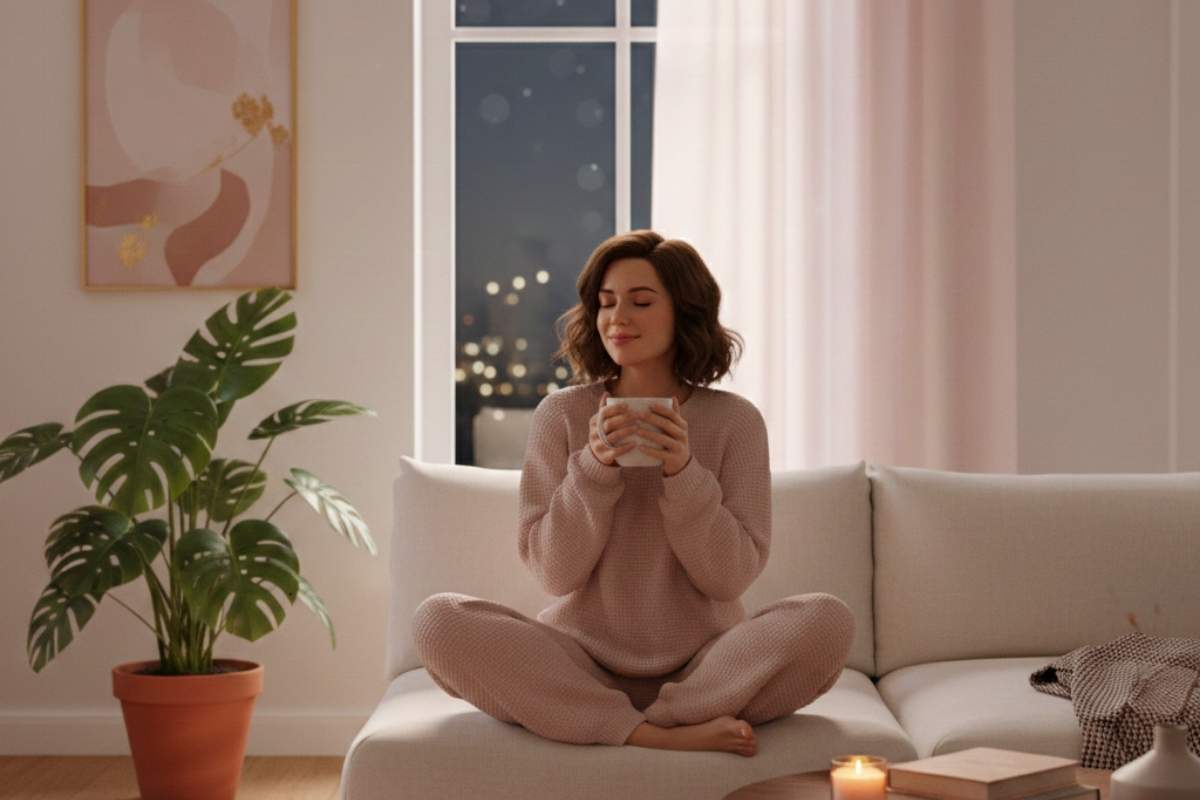
Some nights, you’re not scared. You’re just… more aware.
You’re lying in bed, the apartment quiet in that way it only gets after dark, and suddenly everything feels sharper.
The silence. The sounds. The fact that it’s just you there.
You check the lock even though you remember locking it. You listen a little harder than you did during the day. You keep your phone close, not because you expect something to happen — but because it feels better that way.
Nothing is wrong.
But your body hasn’t fully relaxed yet.
Living alone during the day feels easy. Empowering, even.
But nighttime brings a different version of independence — one that asks you to hold yourself a little tighter.
And no one really talks about that part.
They talk about freedom. About peace. About loving your own space.
Not about the quiet moments when safety feels less like a checklist and more like something you’re trying to feel.
This isn’t one of those guides filled with rules, steps, or “do this, and you’ll be fine” advice.
It’s not about fixing yourself or turning nighttime into a problem to solve.
It’s a conversation — about why nights feel different when you live alone, and how to meet that feeling with a little more understanding and a lot less self-judgment.
If you’ve ever wondered why nights feel heavier after dark — even when you’re doing everything right — you’re in the right place.
Small Things That Help Me Feel Safer at Night
This isn’t about gear or rules — just a few quiet things that help my body relax once the apartment goes still.
- Motion-sensor night light – A gentle light for moving around at night without harsh brightness.
- White noise machine – Soft background sound that makes the silence feel less heavy.
- Smart bulb or timer plug – makes the apartment feel occupied, even on quiet evenings
- Portable power bank – so my phone is always charged when I need it
None of these are about being afraid — they just make nighttime feel calmer, and that’s enough.
Pin it:
1. When Night Falls and Everything Feels Different
When night falls, it’s not like a switch flips all at once. It’s gradual.
The light outside fades. The sounds change. Neighbors settle in. Traffic thins out.
And without realizing it, you start noticing things you didn’t pay attention to an hour ago.
The quiet gets louder.
You hear the refrigerator click on. A floorboard creaks. Someone closes a door somewhere in the building.
During the day, none of this would even register.
At night, every sound feels closer, sharper, like your senses are suddenly turned all the way up.
You become more aware of your space. Where the doors are. Where the windows are. Which lights are on. Which ones aren’t.
You might walk through your apartment doing little checks — not because you’re scared exactly, but because it feels responsible. Like this is just what you’re supposed to do when you live alone.
And maybe that’s the strangest part.
You’re not panicking. You’re not imagining something bad is about to happen. You’re just… alert.
On edge in a quiet way. As if your body has decided nighttime requires a different version of you — one that listens harder, watches more closely, and doesn’t fully relax yet.
This shift doesn’t mean your home isn’t safe. It doesn’t mean you made the wrong choice by living alone.
It just means nighttime asks more from your nervous system than daytime does.
And when you’re by yourself, there’s no one else’s presence to absorb that extra awareness.
So your body does it for you.
If this sounds familiar, you’re not weak for feeling it. You’re responding to the quiet, the stillness, and the responsibility of being the only one there.
That awareness isn’t a flaw. It’s the starting point of understanding what actually helps you feel safe — not just in theory, but in your body, after dark.
Also Read: Safety Tips for Women Living Alone
2. The Thoughts You Only Have After Dark
There are thoughts that only show up after dark.
They don’t feel dramatic when they arrive — they feel practical, almost reasonable. That’s what makes them so convincing.
You replay the sound you heard ten minutes ago, wondering if it was just the building settling or something else. You picture scenarios you would never think about at noon.
Not because you expect them to happen, but because your mind seems determined to walk through every possibility before it lets you rest.
You might start thinking about things you usually don’t care about.
What if someone tried the door?
What if there was an emergency and you had to handle it alone?
What if you didn’t hear something you were supposed to hear?
The questions stack quietly, one on top of the other, until your chest feels a little tighter than it did earlier.
What’s strange is that these thoughts don’t feel like fear exactly. They feel like responsibility.
Like your brain is saying, stay alert, just in case.
And once that mode switches on, it’s hard to turn it off with logic alone. Telling yourself you’re safe doesn’t always reach the part of you that’s listening right now.
You might even feel annoyed with yourself for thinking this way.
You tell yourself you’re capable, independent, strong — all true things. But independence doesn’t mean your mind shuts off at night. It just means there’s no one else there to share the watch.
So your thoughts do it instead.
If you’ve ever felt your brain become busier the moment the lights go off, there’s nothing wrong with you.
This is what a mind does when it cares about keeping you safe.
The problem isn’t the thoughts themselves. It’s that they don’t know when to stop.
And learning how to quiet them doesn’t start with forcing calm. It starts with understanding why they’re there in the first place.
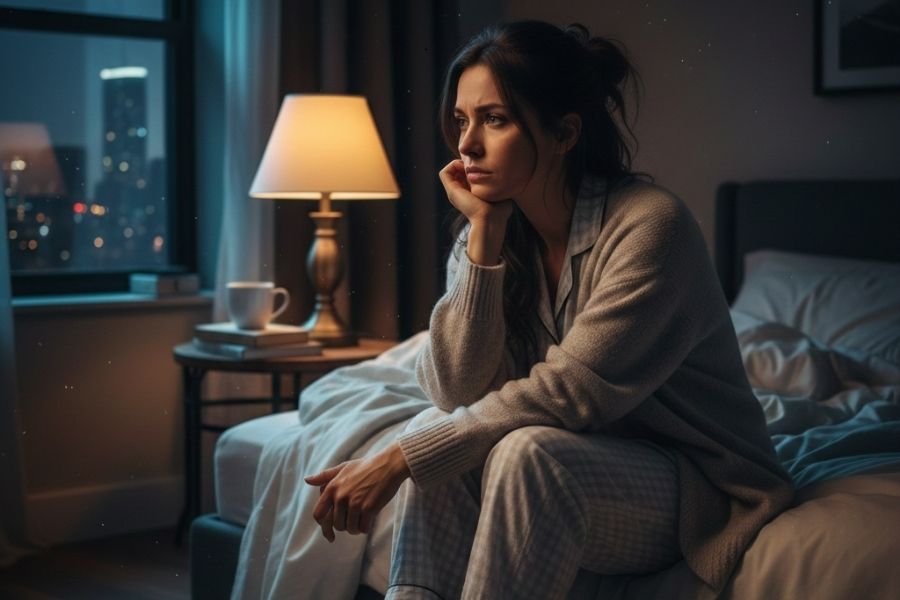
3. Why Living Alone Makes Nighttime Feel Scarier (Even If You’re Strong)
Living alone doesn’t make you unsafe.
But it does change how your body experiences nighttime.
During the day, your nervous system has constant signals that everything is fine.
Light, movement, background noise, other people going about their lives. Even if you’re alone, the world feels awake with you. There’s a sense of shared presence, whether you notice it or not.
At night, all of that pulls back.
The lights dim. The noise fades. The world goes quiet in a way that feels personal when you’re the only one in your space.
There’s no second set of footsteps, no other breathing in the room, no casual reassurance that someone else is there if something happens. Your body registers that absence before your mind can explain it.
So it steps in.
It heightens awareness. It sharpens hearing. It keeps you slightly alert, even when you want to relax.
Not because you’re afraid — but because you’re the only one responsible for yourself in that moment.
And for a body designed to protect you, that responsibility matters.
This has nothing to do with strength. You can be confident, independent, completely at peace with living alone — and still feel more sensitive at night.
These reactions aren’t signs that something is wrong. They’re signs that your system is doing exactly what it was built to do when the world goes quiet.
Once you understand this, something important shifts.
You stop asking, “Why am I like this?” And you start asking, “What does my body need right now to feel safe enough to rest?”
And that question changes everything.
Because feeling safe at night isn’t about convincing yourself there’s no danger. It’s about giving your nervous system enough signals to stand down — gently, without force, and without shame.
Also Read: 12 Things to Keep Near Your Bedside If You Live Alone
4. Small Things That Quietly Tell Your Body You’re Safe
Feeling safe at night usually isn’t about one big thing. It’s about a series of small signals your body picks up on without you realizing it.
Little cues that tell your nervous system, you’re okay here.
Light is one of the first.
Complete darkness can make your mind fill in gaps that don’t need filling.
A soft lamp, a hallway light, even the glow from the kitchen can make a space feel less unknown.
You’re not leaving lights on because you’re scared. You’re leaving them on because your body relaxes when it can see.
Sound works the same way. Total silence gives your thoughts too much room.
That’s why background noise helps — a show you’ve already watched, a familiar podcast, low music. Something predictable. Something that tells your brain the night is normal and moving along just like it always does.
Then there’s visibility. Knowing what’s around you without having to wonder.
Curtains closed when you want privacy. Doors and windows checked in a way that feels intentional, not frantic.
When you know your space is settled, your mind doesn’t keep scanning for unfinished business.
Even temperature matters.
Being warm enough. Wrapped in a blanket. Holding something solid.
These are physical reminders that you’re grounded and protected, not floating alone in the dark.
None of these things are dramatic. No one would call them “security measures.”
But together, they create a quiet sense of control. Not control over the world — just over your immediate space.
And for your nervous system, that’s often enough.
Safety, at night, is less about preparing for something bad and more about removing uncertainty.
When your body knows what to expect — what it can see, hear, and feel — it doesn’t have to stay on high alert.
And once that alertness softens, rest becomes possible.
Also Read: 21 Smart Safety Tips for Walking Alone at Night
5. Your Night Routine Is Your Real Safety Net
A night routine isn’t about being disciplined or doing things “the right way.” When you live alone, it becomes something else entirely.
It’s a signal. A pattern your body learns to trust.
When you do the same small things each night — locking up, turning off certain lights, changing into sleep clothes, settling into one spot — your body starts to recognize what’s coming next.
It learns that nothing needs your attention anymore. That the day has officially ended.
You might already have parts of this routine without realizing it.
The way you check the door before bed. The order you turn lights off. The spot where you put your phone down.
These aren’t habits you need to fix. They’re habits your body created to feel settled.
The problem is when you rush through them or second-guess them.
When you lock the door, but don’t pause long enough to register that it’s locked.
When you check something and immediately wonder if you actually did.
That uncertainty keeps your mind hovering instead of landing.
Slowing down helps more than repeating things.
Touch the lock. Hear the click. Let yourself notice it. Not to reassure yourself out loud — just to let your body take in the fact that the task is done.
A routine works best when it feels calming, not strict.
A warm shower. Folding into bed the same way each night. Turning on a familiar show for a few minutes.
These are quiet transitions from alertness to rest.
Over time, your routine becomes a safety net. Not because it prevents anything from happening, but because it teaches your body what safety feels like.
And once your body recognizes that feeling, it stops asking for constant proof.
6. Noises, Knocks, and That Sudden Jolt of Fear
Even with routines and soft lights and familiar sounds, fear can still show up out of nowhere.
A noise you weren’t expecting. A sudden knock. Something falling in another apartment. That sharp jolt in your chest before your brain has time to catch up.
When that happens, your body reacts first.
Heart racing. Muscles tense. Breath shallow. It’s not because you’re in danger — it’s because your system thinks it might need to be ready.
The worst thing you can do in these moments is rush yourself to calm down.
Telling yourself “it’s nothing” too quickly often makes the fear louder, not quieter. Your body doesn’t need convincing. It needs grounding.
Pause where you are. Put your feet on the floor. Notice something solid — the couch under you, the bed, the wall. Let your breath slow naturally instead of forcing it.
You don’t have to investigate right away. You don’t have to decide what the sound was. You just need to let your body come back online.
Then, when the initial surge passes, you can respond from a steadier place.
You might turn on a light. Check what needs checking. Text someone just to break the isolation.
These aren’t signs of weakness. They’re ways of bringing your nervous system back into the present.
What helps most is reminding yourself — quietly, without drama — that you’re allowed to take your time.
There’s no rule that says you have to handle nighttime fear perfectly. There’s no prize for staying frozen or powering through alone.
Fear passes faster when it feels acknowledged instead of fought.
And once you learn how to meet those moments without panicking, they start to lose their power.
Not because they stop happening, but because you trust yourself to move through them.
7. What Actually Helps When You Still Feel Unsafe
Some nights, even after you’ve done everything “right,” you still don’t feel fully safe.
The lights are on. The doors are locked. Your routine is done. And yet there’s a quiet unease that won’t completely settle.
This is the part no one really talks about.
Because feeling safe isn’t a switch. It’s a spectrum.
And some nights, you land somewhere in the middle.
On those nights, what helps most isn’t trying to eliminate the feeling. It’s giving yourself permission to respond to it without judgment.
You might text someone just to feel another presence in the world.
You might keep a show playing until sleep sneaks up on you.
You might hold your phone a little longer, or fall asleep with the light still on.
None of that means you’re doing something wrong.
Sometimes safety comes from connection.
Sometimes it comes from distraction.
Sometimes it comes from familiarity.
And sometimes it comes from letting yourself choose comfort over rules.
You don’t have to prove anything to anyone when you’re alone at night. You don’t have to be brave in a specific way.
You just have to get through the evening in a way that feels kind to your body.
The more you allow yourself to meet these nights as they are, the less power they have over you. Not because the fear disappears, but because it stops feeling like a failure.
And that shift — from fighting the feeling to accommodating it — is often what finally lets sleep arrive.
8. You’re Not Broken for Feeling This Way
At some point, a lot of women start wondering if this feeling means something is wrong with them.
You might tell yourself that you should be more relaxed by now.
That other people don’t think this way. That if you were truly comfortable living alone, nights wouldn’t feel like this sometimes.
That thought can be heavier than the fear itself.
But there’s nothing broken about you.
Your body hasn’t failed to adjust. Your mind isn’t weak. You’re not doing independence incorrectly.
You’re responding to quiet, responsibility, and awareness — all at once.
Living alone doesn’t mean you stop needing reassurance.
It just means you learn how to give it to yourself.
And that takes time. It takes patience. It takes nights where you feel okay, and nights where you don’t.
Needing comfort doesn’t cancel strength. Wanting safety doesn’t mean you’re afraid of life. It means you’re human.
Once you stop treating this feeling like a flaw, it softens on its own.
Not because it disappears, but because it no longer feels like a personal failure.
9. Things That Personally Make Me Feel Safer at Night
There are a few things that make nights feel easier for me. Not because they guarantee safety, but because they help my body relax enough to rest.
I like having one light on somewhere — not bright, not harsh. Just enough that I can see the shape of the room if I open my eyes.
Darkness doesn’t scare me, but it makes my mind wander, and I don’t need that at midnight.
I almost always keep something playing quietly in the background.
A show I’ve already seen, a familiar voice, something predictable.
Silence feels too open some nights, like it’s waiting for my thoughts to fill it.
Before bed, I do a slow walk through my space.
I check the door once. I look at the windows. Not in a rush. Not to reassure myself over and over. Just to let my body register that everything is settled.
I keep my phone close. Not because I expect to need it — but because knowing it’s there makes me feel less alone.
Sometimes I text someone. Sometimes I don’t. Just having the option matters.
And when a night feels heavier than usual, I let myself choose comfort without overthinking it.
I sleep with the light on. I stay up a little later. I wrap myself in blankets like a shield. I don’t argue with what I need.
These things aren’t solutions. They’re supports. Quiet ones. Personal ones.
And over time, they’ve taught me that feeling safe doesn’t have to look perfect — it just has to feel enough.
Also Read: 11 Home Safety Essentials Every Solo Woman Should Own
One Last Thing Before You Go
If you’ve read this far, I want you to know something.
The fact that you think about safety at night doesn’t mean you’re anxious, dramatic, or fragile.
It means you’re aware. It means you care about yourself enough to notice how your body responds when the world goes quiet.
Living alone asks you to hold space for yourself in ways other people never have to think about. Especially at night.
And some evenings, that feels empowering. Other nights, it feels heavy. Both can be true.
You don’t need to turn yourself into someone who never gets scared after dark.
You don’t need to “fix” this feeling or push past it to prove independence. Feeling safe isn’t a personality trait. It’s something you build gently, night after night, in ways that make sense to you.
So if tonight you leave a light on, or keep a show playing, or check the lock one extra time — let that be okay. You’re not doing it because you’re afraid. You’re doing it because you’re listening to yourself.
And that matters.
You’re allowed to create a version of nighttime that feels softer. One where your home doesn’t just protect you, but comforts you. One where you can rest without being on guard.
You’re not alone in this feeling — even when you’re alone in your space.