
Home Maintenance Tools Every Woman Living Alone Actually Needs
A real toolkit guide for women living alone, written by someone who’s been renting for 8 years. Three kits (starter, renter, homeowner), what to skip, and how to buy tools that actually fit your hands.
The curtain rod came down at 11:47 on a Tuesday night.
I was standing on my bed in pajamas, holding two halves of a curtain rod and a pile of plaster dust, when I realized I didn’t own a single screwdriver. Not one.
I’d lived in that apartment for fourteen months and was about to text my downstairs neighbor at midnight to ask if I could borrow a hammer.
I didn’t text him. I shoved the curtains in a drawer and went to bed angry, not at the rod, at myself.
Here’s what nobody tells you when you start living alone:
- There’s no toolbox-shaped welcome basket when you sign your first lease
- The internet wants to sell you a 200-piece “essentials kit” that’s mostly drill bits you’ll never use
- Your dad means well, but he’s recommending the 18V drill that weighs more than your cat
- And every “tools every woman needs” article is either condescending or pink
So this is the list I wish someone had handed me at 23.
Three tiers:
- A starter kit you can throw together for under fifty bucks
- A renter’s add-on for when you stop being scared of your walls
- And an upgrade kit for if you ever own a place
- Plus a short “skip these” section because half the battle is knowing what NOT to buy
Let’s get into it.
1. The 10-Minute Starter Kit (Under About $50)
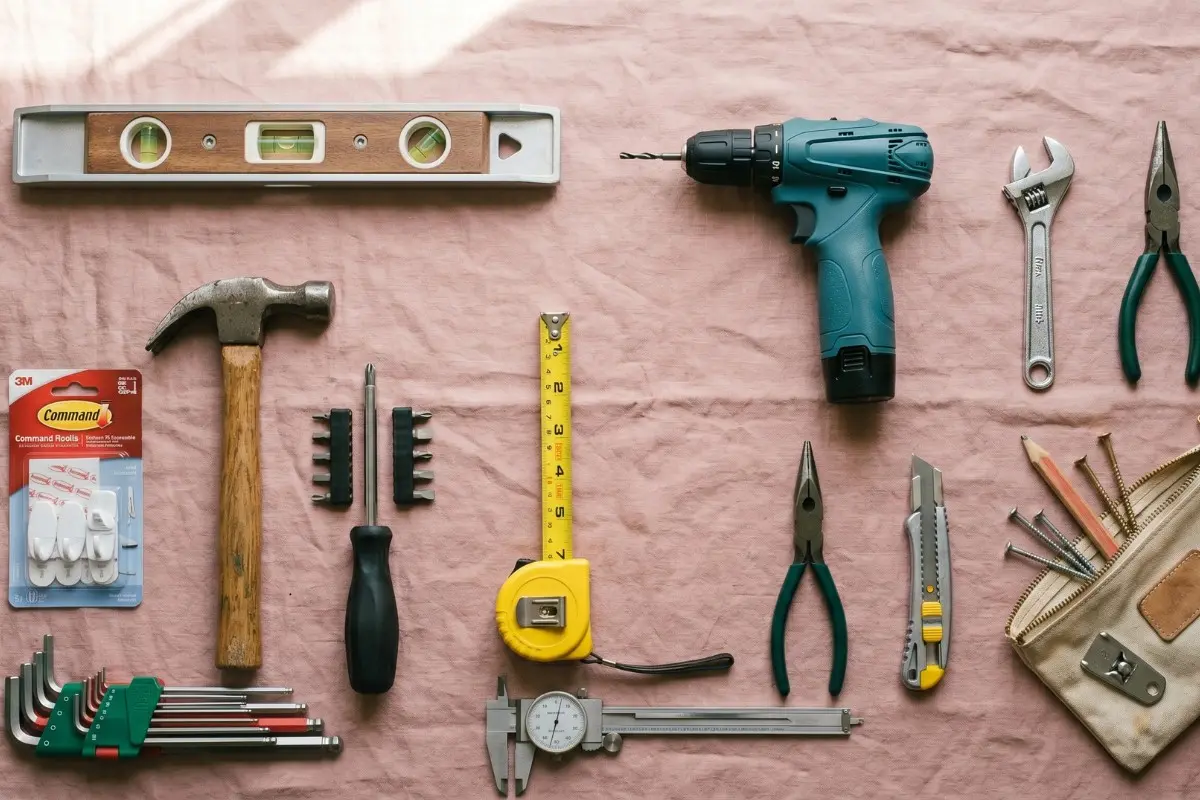
This is the kit that lives in a small canvas bag in the bottom drawer of my kitchen.
Not a toolbox. A bag. Because here’s what I learned:
If your tools live in a heavy plastic toolbox in a closet, you will not use them. You will improvise with a butter knife and resent your own apartment. The bag goes from kitchen to bathroom to bedroom in one hand, and that’s the whole point.
Eight things. That’s it.
Total weight comes in under four pounds, and it’ll handle maybe 80% of the small stuff that goes wrong in a one-bedroom apartment.
1.1 A multi-bit screwdriver
If you buy one tool from this entire article, buy this one.
It’s a single handle with interchangeable bits stored in the shaft — Phillips, flathead, the small ones for eyeglass screws, the ones for battery compartments.
I’ve had mine for six years, and it has tightened more cabinet handles, opened more battery covers, and assembled more IKEA furniture than any other thing I own.
Skip the giant ratcheting versions. Get a basic one with around 6–10 bits stored in the handle.
This is the exact one I use — See on Amazon
1.2 A claw hammer (8oz, not 16 oz)
Every tool guide written by a man will tell you to buy a 16-oz hammer. Don’t.
An 8 or 12-oz hammer drives a picture nail into drywall just fine, and your wrist will thank you the next morning.
Mine has a fiberglass handle, which absorbs shock better than wood. I noticed the difference the first time I had to hang a gallery wall, and my arm wasn’t sore by photo number eight.
This one’s worth it — See on Amazon
1.3 A 16-foot tape measure
The 25-foot ones are heavier, and you will never need that much length in an apartment.
I use my tape measure roughly twice a week, checking if a couch fits, measuring a wall before buying art, figuring out if a rug is the right size, and the 16-foot is what I’ve happily kept for years.
I have this — See on Amazon
1.4 A small adjustable wrench
This is the tool that saved me the night my showerhead started spraying sideways.
The hex nut behind it had loosened, and a 6-inch adjustable wrench was exactly the right size to fit into that awkward space behind the wall plate.
The bigger 10-inch wrenches in starter kits look more impressive, but they don’t fit anywhere useful in a normal apartment.
This one’s worth it — See on Amazon
1.5 Needle-nose pliers
For pulling things out of drains, bending small wires, holding tiny screws while you start them, retrieving the earring back that fell behind the dresser.
Boring tool, used constantly.
I use this one — See on Amazon
1.6 A small level (or honestly, your phone)
I’ll be straight with you: I bought a 9-inch torpedo level five years ago, and I think I’ve used it twice.
The level app on your phone genuinely works for hanging shelves and pictures.
If you want a physical one, a small magnetic torpedo level is fine and costs under ten bucks. Don’t spend more.
I’d recommend this one — See on Amazon
1.7 A retractable utility knife
For opening boxes (you’ll get a lot of boxes), trimming weatherstripping, scoring drywall if you ever need to, cutting carpet pad.
Get one with a blade that fully retracts so you don’t slice your hand reaching into the bag.
This one’s worth it — See on Amazon
1.8 A small canvas tool bag
Skip the hard plastic toolbox. They’re heavy, they’re loud, and they don’t fit anywhere.
A 10–12 inch canvas bag with a few external pockets holds everything in this kit and tucks into a drawer or under a sink.
Mine is from a brand that makes electrician’s bags, and it has held up for years of being thrown around.
This is a solid option — See on Amazon
That’s the starter kit. Total cost if you buy decent mid-range pieces: somewhere around $40–55, depending on what’s on sale.
Total weight under four pounds. Total time it’ll save you over the next year: more than you’d think.
Read this: Home Maintenance for Women Living Alone: The Complete Guide
2. The Renter’s Add-On Kit
Here’s the thing nobody tells you about renting: you spend years feeling like you shouldn’t invest in your own apartment because it isn’t really yours.
- Why buy a drill for a place you might leave in eighteen months?
- Why hang heavy art on walls you’ll have to patch?
- Why care about the apartment at all when the lease is temporary?
I lived like that for the first two years on my own.
Cardboard boxes as nightstands, posters held up with washi tape, a single floor lamp because I was scared to put a hole in anything.
And then it hit me: the tools come with you. The drill I bought at 23 is still drilling holes at 33. The walls are temporary. The kit is permanent.
So here’s what to add when you’re ready to stop being scared of your apartment.
2.1 A 12V cordless drill
This is the tool that changes your life.
I’m not exaggerating. The first time I used a drill instead of trying to muscle a screw in with a screwdriver, I felt like I’d been doing everything wrong for years.
Hanging shelves, assembling furniture, mounting a curtain rod that won’t fall down at midnight, all of it goes from a 30-minute job to a 5-minute one.
But please, for the love of your wrists, get a 12V drill, not an 18V.
Every single tool guide written for a general audience will recommend an 18V because that’s what a contractor uses on a job site.
You are not a contractor. You are putting a hook in your hallway.
The 12V weighs around 2.2 pounds, the 18V weighs closer to 3.8, and that pound and a half matters when you’re holding it overhead trying to reach a stud.
I’ve had a WORKPRO 12V for about five years, and it still drives screws into hardwood without complaining.
Other brands worth looking at are the smaller DeWalt 12V or the Bosch 12V, all in roughly the same price range.
The brand you pick locks you into that battery system for future tools, so think of the drill as a starter investment, not a one-off purchase.
One more thing: get one with a brushless motor if it’s in budget. The batteries last roughly twice as long, and the tool itself runs cooler. It’s the upgrade I noticed immediately when I replaced my first drill.
I have this — See on Amazon
2.2 A drill bit and driver bit set
When you buy your first drill, it’ll come with maybe two bits. You need more.
A combo pack with assorted drill bits (for making holes) and driver bits (for driving screws) covers about 95% of household jobs.
Skip the 100-piece sets, most of those bits are for materials you’ll never work with. A 30–40 piece kit is plenty.
I have both of these at home — Drill Bit Set and Driver Bit Set
2.3 A stud finder
Walls are a mystery until you own one of these.
Studs are the wooden beams behind drywall, and anything heavy, a TV mount, a floating shelf, a heavy mirror, needs to be screwed into a stud or it will eventually rip out of the wall and take a chunk of plaster with it.
A basic magnetic stud finder costs under fifteen bucks and works by sensing the screws holding the drywall to the studs.
It’s slower than the electronic kind, but it never needs batteries, and it’s almost impossible to get a wrong reading.
If you want to upgrade, an entry-level electronic stud finder runs $20–30 and is faster, but the magnetic one is genuinely all most renters need.
I have both. I use the magnetic one 90% of the time.
This one’s worth it — See on Amazon
2.4 A picture-hanging assortment
The little cardboard boxes with assorted hooks, anchors, and nails — buy one.
They’re cheap, they include the picture-hanging hooks rated for different weights (5 lbs, 10 lbs, 20 lbs, etc.), and the wall anchors save you when you can’t find a stud where you want to hang something heavy.
For walls where you can’t drill at all (some leases, some weird brick situations), there are also adhesive strips that hold up to about 16 pounds.
They actually work, but only on smooth painted walls, they fall off textured paint and wallpaper.
This is a solid option — See on Amazon
2.5 A headlamp
I know. A headlamp sounds extreme for an apartment. Hear me out.
The first time I tried to fix something under my bathroom sink, I balanced a flashlight on a stack of toilet paper rolls, and it kept rolling off into the cabinet while
I was holding two wrenches.
The second time, I held a flashlight in my mouth. The third time, I bought a $15 headlamp and have never gone back.
Anything you have to fix in a dark space, under a sink, behind a toilet, inside a closet, in a basement storage unit, needs both hands free, and a headlamp gives you that.
Get one with a red-light mode if you can. It’s better for late-night work because it doesn’t kill your night vision.
This is the one I use — See on Amazon
2.6 A drain snake (the cheap plastic one)
Hair clogs in the bathroom drain are inevitable, and a plumber visit for a hair clog is fifty to a hundred dollars.
A 24-inch flexible plastic drain snake costs under five dollars, comes in a pack of three, and fishes out the entire situation in about ninety seconds.
I keep one under each sink. They’re disposable, slightly disgusting to use, and one of the best money-savers in this whole article.
This one’s worth it — See on Amazon
2.7 A flange plunger (not a cup plunger)
The plunger you grew up seeing, the wooden handle with a red rubber cup, is a sink plunger.
It does not work well on toilets.
The plunger you actually want for a toilet has an extra rubber flap that folds out from inside the cup, called a flange. It creates a real seal in a toilet drain and clears clogs that a cup plunger just sort of slaps at uselessly.
Get a flange plunger. Keep it in the bathroom, ideally in a discreet holder.
You will need it eventually, and you will be grateful that you bought it before the emergency, not during.
This is a solid option — See on Amazon
That’s the renter kit. Add this to the starter kit, and you’re handling probably 95% of what goes wrong in a rental, plus you stop being intimidated by your own walls.
Total spend, somewhere around $150–200, depending on the drill you pick. Worth every dollar, and all of it comes with you to the next place.
3. The Homeowner Upgrade Kit
I’ll be straight with you upfront: I don’t own a home. I’ve been renting for almost eight years, and the starter and renter kits above are what I actually live with day to day.
So this section works a little differently.
It’s built from what my friends who own places have told me they wish they’d bought sooner, what shows up consistently in homeowner forums and review patterns, and the handful of these tools I’ve used at my parents’ house or borrowed from neighbors when something needed doing.
Here’s the upgrade kit, and the honest reasoning for each piece.
3.1 A 3-step ladder
This is the one piece every homeowner friend of mine has independently said, “buy this first.”
A 3-step lightweight aluminum ladder weighs around eight pounds, folds flat enough to slide behind a door or into a closet, and gets you to ceiling height for changing smoke detector batteries, replacing light bulbs in overhead fixtures, dusting the tops of cabinets, and reaching the top shelf in your closet without standing on a chair like you’re trying to die.
My friend Emma bought a place last year and told me she used the ladder twice a week for the first month.
Reviews back this up, the most common pattern across thousands of reviews is some version of “didn’t think I needed this and now I use it constantly.”
Skip the cheap fold-out step stools. They wobble, they’re rated for lower weight, and they don’t go high enough.
This is the one I suggest — See on Amazon
3.2 An 18V cordless drill or impact driver
Now you can justify the bigger drill.
The 12V from your renter kit still works for indoor wall jobs, but if you own a place, you’ll eventually be drilling into hardwood, deck boards, masonry, or fence posts — and that’s where the 18V earns its weight.
The split between regular drill and impact driver matters here.
A drill drills holes and drives screws. An impact driver drives screws faster and harder using rotational impacts, which is what you want when you’re sinking long deck screws or driving into dense wood.
Most homeowners I know eventually own both — they often come bundled in a combo kit from DeWalt, which is the cheaper way to get there than buying separately.
If I were buying my first 18V tool tomorrow, the patterns I keep seeing in reviews and from friends point toward the DeWalt 20V Max combo kit (drill + impact driver) as the safest first investment.
Go for the kit — See on Amazon
3.3 A caulk gun and a few tubes of caulk
Caulk is the soft sealant that fills the gap between your bathtub and the wall, around your kitchen sink, and along window seams.
It cracks and pulls away over time, which lets water seep into places it shouldn’t, which becomes mold, which becomes an expensive problem.
Re-caulking a bathtub once a year or two is a 30-minute job that saves you thousands in water damage repair.
The caulk gun itself is under fifteen dollars. Get a basic ratcheting one, the smooth-rod ones drip and waste caulk. For the caulk itself, a kitchen and bath silicone formula handles most household jobs.
My friend Sarah re-caulked her entire bathroom on a Saturday afternoon for under thirty bucks total, and the same job from a handyman was quoted at $250.
This is the one I suggest — See on Amazon
3.4 A small wet/dry shop vacuum
The 2 to 3-gallon size is the sweet spot for homeowners.
It handles spilled cereal, basement leaks, the disgusting situation behind your dryer, sawdust from any project, and the gross water that comes out of a clogged dishwasher line.
Regular vacuums can’t handle wet messes, water destroys the motor.
This is one of those tools that sits in a corner for months and then becomes the most important object in your house for one specific bad afternoon.
The reviews on these are full of “saved my basement” stories. Ridgid and Shop-Vac are the two brands that come up consistently as reliable in this size class.
I’d recommend this one — See on Amazon
3.5 A basic multimeter
A multimeter measures electrical things, whether an outlet has power, whether a battery still has juice, whether a fuse is blown.
You don’t need a fancy one. A basic digital multimeter under $15 covers everything a non-electrician homeowner would test.
The honest reason to own one is that it lets you figure out whether the problem is the appliance or the outlet before you call an electrician.
My neighbor Tom (he’s like 65, owns his place, fixes everything himself) told me he uses his multimeter at least twice a month, mostly to check whether weird electrical issues are actually the appliance dying or just a tripped breaker behind the scenes.
This is the one he has — See on Amazon
3.6 A small pipe wrench
For under-sink work, replacing a faucet, dealing with the trap pipe, tightening a wobbly toilet supply line.
A 6-inch adjustable wrench (in your starter kit) handles a lot, but a real pipe wrench grabs round metal pipes the way an adjustable can’t. The serrated jaws bite into the pipe so it actually turns instead of slipping.
You don’t need the giant 18-inch ones plumbers use. A 10 or 12-inch pipe wrench fits under most sinks and weighs a third as much.
This one’s worth it — See on Amazon
3.7 Work gloves that actually fit a smaller hand
This is the gap in the tool market that nobody fixes.
Most work gloves are sized for an average man’s hand, which means on most women, they’re loose, the fingertips are floppy, and you can’t grip anything precisely.
A loose glove is almost worse than no glove because you lose dexterity without gaining real protection.
Look for brands that make gloves in actual women’s sizing — Mechanix Wear, Ironclad, and a few smaller brands like StoneBreaker do this well.
The fit difference is genuinely huge.
I suggest getting this one — See on Amazon
That’s the upgrade kit. Total spend if you bought everything at once is probably $300–450, depending on the drill combo you choose, but you really shouldn’t buy it all at once.
Spread it out across the first year or two and let your actual problems tell you which piece to grab next.
4. The “By Repair” Add-Ons (Buy When You Need Them)
Not every tool belongs in your everyday kit.
Some are problem-specific, meaning you buy them the day a particular thing breaks, and they earn their keep in one job.
Here’s a quick reference for the most common situations, with the exact tool that solves it.
4.1 Clogged bathroom drain
The hair-catcher drain snake I mentioned in the renter kit is your first move.
If that doesn’t work, the next step up is a hand-crank metal drum auger, which costs about $20 and reaches further down the pipe.
Don’t go straight to chemical drain cleaners. They damage older pipes and rarely work on a real hair clog.
The mechanical fix almost always wins.
4.2 Squeaky door hinge
Skip the standard WD-40 in the blue and yellow can for this one.
It’s a degreaser and rust loosener, not a long-term lubricant, so the squeak comes back in a few weeks.
What you actually want is a silicone-based lubricant or a dry PTFE spray.
Both run about $8, and the squeak stays gone for months. One spray on the hinge pin, work the door back and forth a few times, done.
4.3 Wobbly furniture
Self-adhesive felt pads for the bottom of chair and table legs solve maybe 70% of wobble situations because most wobbles are actually uneven floors.
The pad lets you adjust thickness on the short leg until things sit flat.
For dressers and bookcases, screw-in adjustable furniture levelers do the same job with more precision. Both cost under $10 a pack.
4.4 Hanging things on plaster walls
If you live in an older building, your walls might be plaster instead of drywall.
Plaster crumbles when you drill into it without prep, and regular drywall anchors don’t hold.
The fix is either picture rail hooks (if your apartment has the rail molding near the ceiling, which a lot of pre-war buildings do) or specialty plaster anchors that have a sleeve which expands behind the wall.
Both work. Picture rail hooks are nicer because you don’t put any holes in the wall at all.
4.5 Stuck garbage disposal
When the disposal hums but doesn’t spin, something is jamming the blades.
There’s a small hex socket on the bottom of every disposal, and the tool to free it is a quarter-inch Allen wrench, also called a hex key.
The disposal probably came with one taped to the unit, but everyone loses theirs eventually.
A $5 Allen wrench set covers this and a hundred other small jobs.
4.6 Drafty windows in winter
Two products, used together. A roll of foam weatherstripping seals the gaps along the window frame where cold air sneaks in.
A window insulation kit, which is basically clear plastic film and double-sided tape, creates a second air barrier across the whole window.
Hair dryer to shrink the film tight, and you’ve cut your heating bill noticeably for under $25 of supplies.
My apartment in my second year had single-pane windows, and this combination was the difference between wearing a coat indoors and not.
4.7 Loose cabinet handle or drawer pull
Just a screwdriver, but probably not the one you’d reach for.
Most cabinet hardware uses a Phillips #1 bit, which is smaller than the standard Phillips #2 most people own.
Using a #2 in a #1 screw strips the head over time.
The multi-bit screwdriver in your starter kit should have both sizes. Check before you start tightening.
4.8 Toilet running constantly
The fix is almost always a new flapper, which is the rubber piece at the bottom of the tank that lifts when you flush.
They cost about $5, last about five years, and replacing one takes ten minutes with no tools beyond your hands.
If your toilet is running, lift the tank lid and look at the flapper. If it’s warped, cracked, or stained dark, it needs replacing.
4.9 Leaky faucet
Most faucet leaks are a worn-out cartridge or O-ring inside the handle.
The repair kit specific to your faucet brand and model runs $10 to $25, and the swap takes about 20 minutes.
The pipe wrench I mentioned in the homeowner kit helps, but isn’t strictly required for most modern faucets.
Watch a YouTube video specific to your faucet brand before starting because the cartridge release mechanism varies.
5. What to Skip (The Marketing Traps)
Four things I’d talk you out of buying.
5.1 The 200-piece “complete home toolkit”
The case looks impressive, but most of the pieces are filler drill bits and sockets you’ll never use.
The actual hammer and screwdrivers are the cheapest possible versions, and the hammer head usually loosens within a year.
Buy eight good individual tools instead of a hundred and twenty bad ones.
5.2 Anything in pink or floral packaging marketed “for women”
The “for her” tool sets are almost always lower quality than the unisex equivalent at the same price, often marked up specifically because of the marketing.
If you want tools that fit smaller hands, look for compact or lightweight versions of regular tools, not gendered branded ones.
5.3 Multi-tool gadgets
- The screwdriver with a built-in level and flashlight
- The hammer with a measuring tape inside the handle
These fail at all their jobs because the engineering compromises ruin every function.
A regular hammer, a real tape measure, plus a real flashlight beats any combo gadget.
5.4 Smart stud finders over $40
A basic magnetic stud finder costs $10 to $15 and works almost perfectly.
The expensive ones with Bluetooth and apps don’t help you hang a shelf any better. If you ever genuinely need a wall scanner for plumbing or wiring, you can rent one from a hardware store for an afternoon.
6. How to Buy Tools That Actually Fit You
Here’s the thing tool guides almost never mention that tools come in one size, but bodies don’t.
I’m 5’4″, I have small hands, and I’ve never done strength training in my life. My friend Emma is 5’9″ with hands the size of my dad’s.
The same drill is going to feel completely different in our hands, and the standard tool review on the internet was written by someone built nothing like either of us.
Over the years, I’ve worked out a quick set of in-store tests (or at-home tests if you’re buying online and willing to return) that tell you whether a tool will actually work for your body.
Four checks, takes about thirty seconds.
6.1 The grip test
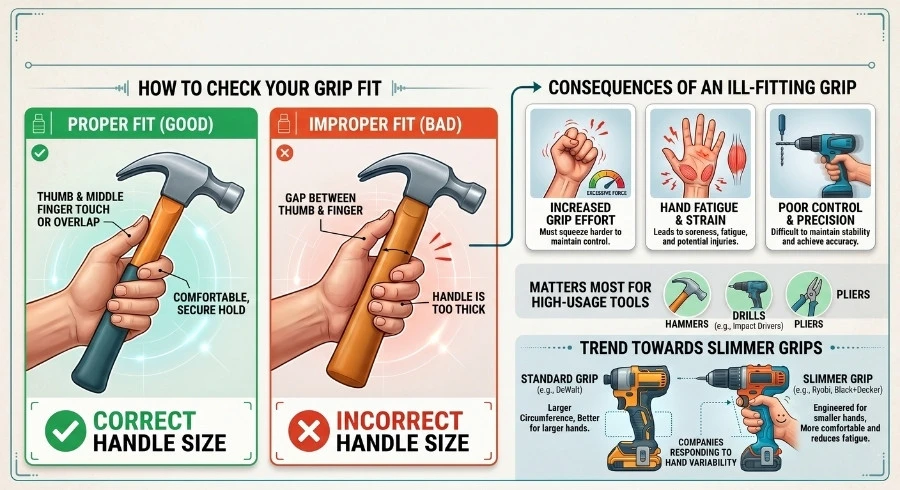
Wrap your thumb and middle finger around the tool’s handle. They should comfortably touch or overlap.
If there’s a gap between them, the handle is too thick for your hand, which means you’ll grip it harder to compensate, which means hand fatigue and worse control.
This matters most for hammers, drills, and pliers. Some brands now make slimmer-grip versions of standard tools specifically because the engineering teams (finally) figured out that not every hand is the same size.
6.2 The arm-out test
Pick the tool up with one hand and hold it straight out at arm’s length for ten seconds.
If your wrist starts shaking or your shoulder gets tired before the ten seconds is up, the tool is too heavy for sustained use.
You can still buy it for occasional jobs, but you’ll regret using it for anything that takes more than a minute.
6.3 The trigger test
Squeeze the trigger with one finger. If you have to use two fingers or really clamp down to get it to engage, the trigger spring is too stiff for sustained work.
Cordless drills, glue guns, and caulk guns all have variable trigger weights, and the difference between an easy trigger and a hard one is enormous over a 30-minute job.
6.4 The battery weight check
This one’s specific to cordless tools.
The battery on a cordless drill or impact driver is often heavier than the tool itself, and bigger batteries mean longer runtime but worse balance.
A 4Ah battery weighs roughly twice as much as a 2Ah battery, and on a 12V drill, that’s the difference between a tool that feels balanced and one that feels nose-heavy.
For everyday home use, a 2Ah battery has more than enough runtime. The bigger ones are for contractors who run their drill for hours straight.
If your drill comes with a 4Ah battery and a 2Ah option exists, switch to the smaller one for daily carry.
One last thing: returns are your friend
Almost every cordless tool on Amazon ships with a 30-day return window and includes the battery and charger, so you can do a real test at home. Buy the drill you think you want. Use it on one project. If the grip is wrong or it’s heavier than expected, return it and try a different one. I returned my first drill (a Black+Decker 18V) after three days because the trigger was too stiff. Got the 12V WORKPRO instead and have used it happily ever since. The store didn’t care. The internet didn’t care. You shouldn’t either.
The Real Point
Here’s what’s in my drawer now, almost five years later.
- The full starter kit in its canvas bag
- The 12V WORKPRO drill with two batteries that I’ve genuinely lost count of how many times I’ve used
- The headlamp I bought after the flashlight-in-mouth incident
- A small pile of picture-hanging hooks in assorted sizes
- A flange plunger, I hope I never have to use again, but am grateful exists
- The drain snakes under each sink
- A second multi-bit screwdriver because I keep losing the original one inside couches
I’m still not handy. I want to be clear about that.
- I still call a plumber when something is leaking from the ceiling
- I still pay an electrician when I’m out of my depth, which links to the contractor guide if you’re trying to figure out where that line is
- I still ask my dad questions over the phone when I’m not sure if a project is too big
But the curtain rod doesn’t fall down anymore, and when something small breaks, I fix it in fifteen minutes instead of feeling helpless for three days.
That’s the whole goal. Not handy. Just not stuck.
- Buy the starter kit this week if you don’t have it
- Add the renter pieces over the next few months as the situations come up
If you eventually own a place, slowly grow into the homeowner kit one project at a time. Skip everything in the skip list.
And the next time something breaks at 11:47 on a Tuesday, you’ll have what you need in a small canvas bag in your kitchen drawer.
That’s it. That’s the whole thing.