
Home Maintenance for Women Living Alone: The Complete Guide
Everything a woman living alone needs to know about taking care of her home — from emergency shutoffs to when to call a pro. Real-talk, no jargon.
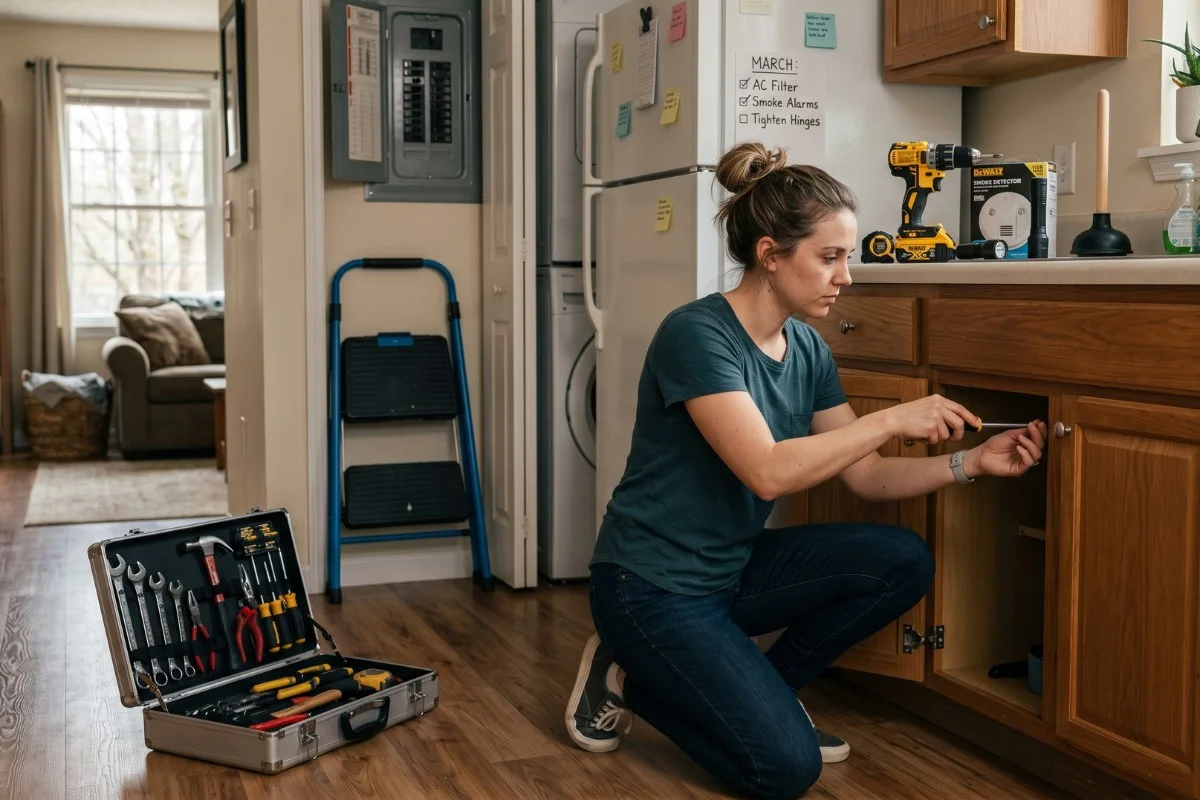
Nobody hands you the map. That’s the part that gets me.
The day you move into your own place, you’re suddenly responsible for an entire layer of adult life nobody ever explained to you. Breaker boxes. Water shutoffs. HVAC filters. P-traps. Caulking. What your landlord has to fix versus what you do. When to call a pro and how to not get overcharged when you do.
It’s not that you’re behind. It’s that nobody walked you through any of it.
I’m seven years into living alone, and I figured this out the hard way, one panicked Google search at a time. So I wrote this guide to be what I wish someone had handed me on day one.
Not a list of skills. Not a checklist. The actual map. The orientation.
- Here’s how your home works
- Here’s what you need to know
- Here’s when to handle it yourself
- Here’s when to call someone
- Here’s how to not get screwed when you do
I’ve linked to deeper guides throughout, so if a section makes you go “okay, but how do I actually do this,” there’s a full walkthrough waiting.
Read this one first. Bookmark it. Come back to it when something breaks.
- 1. Why Home Maintenance Hits Different When You Live Alone
- 2. The Five Systems in Your Home You Need to Understand
- 3. What to Do When Something Actually Breaks
- 4. The Maintenance Calendar (What to Do and When)
- 5. Your Toolkit: What You Actually Need to Own
- 6. Where Your Responsibilities Sit (Rent vs Own)
- 7. When You Need to Hire Someone
- 8. The Safety Layer: What Changes When You’re the Only One Home
- One Last Thing
1. Why Home Maintenance Hits Different When You Live Alone
Home maintenance is hard for everyone. But when you live alone, a few specific things get heavier.
Worth naming them, because they’re not in your head.
1.1 The “Who Do I Call” Freeze
Something breaks. Your first instinct isn’t “let me fix this.” It’s “who do I call?”
Not a plumber. Just… a person. Anyone. A roommate, a partner, a parent, a friend who lives nearby. Someone who might know more than you, or at least someone to stand next to you while you figure it out.
When you live alone, there’s nobody in the next room.
That two-second pause where you reach for help and find nobody there is its own thing. It’s not weakness, it’s not failure. It’s just the reality of doing this solo, and almost every woman I know who lives alone has had a version of it.
The fix isn’t toughening up. It’s having a plan before the moment hits. That’s most of what this guide is.
1.2 What Changes When There’s No One Else to Notice
This is the part people don’t talk about enough.
When two people live somewhere, problems get caught faster:
- One person smells the gas
- The other one hears the dripping
- Somebody notices the smoke detector chirping at 3 AM and gets up to deal with it
When you live alone, you are every one of those people.
Every smell, every sound, every weird stain on the ceiling, every flicker of the lights. You’re the only sensor in the building. If you don’t notice it, nobody does. Not until it’s worse.
That’s not meant to scare you. It’s meant to explain why the small habits in this guide matter more for you than they do for someone with a partner.
A monthly walk-through of your space isn’t paranoia when you live alone. It’s how you catch the $200 problem before it becomes the $5,000 one.
1.3 The Cost of Not Knowing This Stuff
Let me put some numbers down, because the financial side of this is real, and nobody quantifies it for you.
The everyday repair costs:
- Emergency plumber visit: $200–$500
- HVAC repair call starts at: $150
- Burst pipe flooding average: $11,605 in damage
Water damage gets worse on a 24-hour clock:
- First 24 hours: ~$500
- 48 hours: mold starts, $3,000+
- A week: $10,000–$30,000 in reconstruction
The “ignored small stuff” costs:
- A running toilet can waste 200 gallons of water a day
- A dirty HVAC filter shortens the life of a $5,000–$15,000 system
- A clogged dryer vent causes roughly 2,900 house fires a year in the US
I’m not telling you this to spiral you. I’m telling you because almost all of it is preventable with knowledge that takes ten minutes to learn.
The cost of not knowing this stuff isn’t theoretical. It’s a real number, and when you live alone, you’re the one paying it.
2. The Five Systems in Your Home You Need to Understand
Your home isn’t one thing. It’s five systems stacked into a building, and almost every problem you’ll ever have lives inside one of them.
Once you know which system you’re looking at, the problem stops feeling like home maintenance (vague, terrifying) and starts feeling like that one specific thing (manageable).
Here are the five.
2.1 Water
Water comes into your home through one main pipe and leaves through another. In between, it branches out to every sink, toilet, shower, dishwasher, and washing machine you have.
The most important thing to know about your water system is where the main shutoff is. Everything else is secondary.
If a pipe bursts, a toilet overflows, or a hose under your sink fails, the difference between cleanups looks like this:
- First 24 hours: ~$500 cleanup
- 48 hours: mold starts, $3,000+
- A week: $10,000–$30,000 in reconstruction
All of that hinges on how fast you can stop the water.
Find your shutoff today. Not when something goes wrong. Today. Turn it off, turn it back on, take a photo, send the photo to yourself.
The full walkthrough on locating it (apartment vs house, what the valve actually looks like, how to test it) is in the Essential Skills guide.
2.2 Electrical
Your electrical system runs from the utility pole or underground line into a panel inside your home (the breaker box).
From there, it branches into circuits, each one controlling a different chunk of your home, usually a room or two, sometimes a single appliance.
When something electrical goes wrong, the fix is almost always at the panel:
- A tripped breaker
- A GFCI outlet that needs resetting
- A circuit that’s overloaded because you’re running a space heater and a hair dryer on the same line
The 20-minute project that will save you years of stress: open your panel, figure out which switch controls which area of your home, and label them. Future you, standing in the dark at 11 PM, will thank you.
2.3 Gas (If You Have It)
Not every home has gas. If you have a gas stove, gas furnace, gas water heater, or gas dryer, you have a gas system.
If everything in your home is electric, you can skip this part.
For everyone else, three things to know:
- Where your gas shutoff is (usually outside, near the meter)
- What gas smells like — it’s added on purpose, rotten eggs
- The protocol if you ever smell it: don’t touch any switches, don’t light anything, leave the building, call the gas company from outside
Gas is the system you respect, not the system you DIY.
Knowing how to shut it off in an emergency is the only skill you need around gas. Everything past that is a professional’s job.
2.4 HVAC
HVAC stands for heating, ventilation, and air conditioning. It’s the system that keeps your home livable, and it’s the one most likely to die from neglect.
The single most important thing you can do for your HVAC is change the filter every month. That’s it.
That’s the whole maintenance program for most people.
A clogged filter:
- Makes your system work harder
- Drives up your electric bill
- Lowers your air quality
- Is the number one cause of HVAC breakdowns
A filter costs $5–$15. A new HVAC system costs $5,000–$15,000. That math is not hard.
Beyond filter changes, the only HVAC habits worth knowing are scheduling a professional tune-up (spring for AC, fall for heat) and recognizing when a smell or noise from your unit means it’s time to call someone.
2.5 Structure
This is the system people forget exists because it’s mostly hidden. Your walls, floors, ceilings, and roof are doing structural work every day, and what you can see is just the surface.
Most structural maintenance is really just protecting the structure from the other four systems:
- Catching water leaks before they rot wood
- Sealing caulk before water gets behind walls
- Patching drywall before small holes become big ones
- Checking for cracks, soft spots, and stains that show up where they didn’t used to be
You don’t need to understand framing or load-bearing walls. You just need to notice when something has changed.
So what do you actually do with these systems?
Understanding your home’s systems is the orientation layer. The action layer, the actual skills, breaks into four buckets, in order of priority:
- The emergency skills: Shutting off your water, resetting a breaker, knowing the gas protocol. The three things that turn disasters into inconveniences. If you only learn three things, learn these.
- The everyday skills: Changing filters, fixing running toilets, clearing slow drains, replacing smoke detector batteries. The 10-minute habits that save $800–$1,200/year in service calls.
- The “feels harder than it is” skills: Patching drywall, recaulking, hanging shelves, painting. The skills that sound like real handywork but really aren’t.
- What NOT to learn: Anything inside an electrical panel, anything involving gas lines, anything structural. Knowing what to never touch is its own skill, and it’s covered in Section 8.
I wrote a full walkthrough of every skill in each category, what to do, what tools you need, exactly how to do it, in Essential Home Maintenance Skills Every Woman Living Alone Should Know. That guide is the how. This one is the what.
Before you go anywhere, though, find your shutoffs. Right now. Use the tool below.
Find Your Home’s Three Emergency Shutoffs
Walk through your home, find each one, and fill it in below. Your answers save automatically. You can print or screenshot the result for your fridge.
1. Water Shutoff
✓Usually under your kitchen sink, in a utility closet, basement, or near where the main pipe enters the building. Apartments may have a unit shutoff AND a building shutoff — find both.
2. Electrical Panel (Breaker Box)
✓A gray or beige metal box, usually in a hallway closet, garage, basement, or laundry area. Sometimes outside on an exterior wall. Open it once so you know what’s inside.
3. Gas Shutoff (skip if all-electric)
✓If you have a gas stove, gas furnace, gas water heater, or gas dryer, you have gas. Shutoff is usually outside near the meter. You’ll need a wrench to turn it.
Bonus: Emergency Contact
✓One person who lives nearby that you can call at 3 AM if something goes wrong. A neighbor, a friend, a family member.
My Home’s Emergency Shutoffs
Keep this on the fridge. Future you will thank you.
💧 Water Shutoff
⚡ Electrical Panel
🔥 Gas Shutoff
📞 Emergency Contact
📅 Get the calendar that goes with this.
A personalized maintenance calendar built around YOUR home — renter or owner, gas or electric, your climate. Free.
3. What to Do When Something Actually Breaks
Something will break. That’s not pessimism, that’s just owning a body, living in a building, and existing in time.
The question isn’t if, it’s whether you’ll know what to do when it happens.
The good news: there’s a thought process you can run through in about 30 seconds that handles 95% of situations. Once you’ve internalized it, the panic goes way down.
3.1 The First 60 Seconds (Stop the Damage)
Before you figure out what’s wrong, stop it from getting worse.
This is the single biggest mindset shift between people who handle home emergencies well and people who don’t. The instinct is to investigate. The right move is to contain.
The first 60-second checklist looks like this:
- Water everywhere? Shut off the water at the main or the local valve
- Burning smell or smoke? Cut power to that circuit at the breaker, then check
- Gas smell? Don’t touch anything electrical, leave the building, call from outside
- Something flooding from above? Move what you can, contain what you can’t, then deal with the source
You don’t need to know what caused the problem yet. You just need to stop it from getting bigger. Investigation comes after containment, not before.
The actual moves for each scenario (which valve to turn, which breaker to flip, what to grab in what order) are in What to Do When Something Breaks at Home.
3.2 The Triage Framework
Once the immediate damage is contained, you need to figure out how urgent the actual problem is.
Not everything that breaks needs to be fixed tonight. Some things need to be fixed in the next 60 minutes. Others can wait until Saturday.
Here’s the four-level triage I use:
- Level 1 — Life safety: Gas leak, electrical sparking, fire risk, anything carbon-monoxide-related. Drop everything, leave if needed, call 911 or the utility company.
- Level 2 — Active damage: Water leaking, sewage backing up, anything actively destroying your home or things in it. Fix now, even if it’s 2 AM.
- Level 3 — Living disruption: No hot water, no heat in winter, no AC in a heat wave, fridge died, oven broken. Fix today or tomorrow, but you can sleep tonight.
- Level 4 — Cosmetic or convenience: Loose handle, slow drain, squeaky hinge, cracked tile. Fix it when you have time. Or don’t. Nobody dies from a squeaky door.
The mistake almost everyone makes is treating Level 3 and 4 problems with Level 2 urgency.
You don’t need to panic-call a plumber at 11 PM for a slow drain. You also don’t need to wait three weeks for an electrician when your kitchen outlet is sparking. Knowing which level you’re at saves you both panic and money.
Something Just Broke. What Do I Do?
Answer a few quick questions and find out how urgent your situation is — and the first thing to do right now.
Is anyone in immediate danger right now?
Smell gas? See sparks or smoke? Carbon monoxide alarm going off? Active fire? Anything like that.
Is something actively damaging your home or things in it?
Water flowing where it shouldn’t, sewage backing up, ceiling actively leaking, anything that gets worse the longer you wait.
Is this making your home unlivable right now?
No hot water, no heat in winter, no AC in a heat wave, fridge died, stove broken, no working bathroom.
Stop reading and act now.
This is the most urgent category. Your safety comes before everything else, including this guide.
Do this in the next 60 seconds
- If you smell gas: Don’t touch any switches. Don’t light anything. Leave the building. Call the gas company from outside, or 911 if you can’t reach them.
- If you see fire or smoke: Get out. Close doors behind you. Call 911 once you’re outside.
- If you see electrical sparks or smell burning plastic from an outlet: Cut power to that circuit at the breaker, then call an electrician. If you can’t safely reach the breaker, leave and call 911.
- If your CO alarm is going off: Leave immediately. Call 911 or the gas company from outside. Do not go back in until they clear it.
Stop the damage first. Investigate second.
Every minute matters here. The cost of water damage doubles every 24 hours. Your first job is containment, not figuring out what caused it.
Do this in the next 60 seconds
- Water leaking or flooding: Shut off water at the main valve (or at the local valve under the fixture, if you can identify it fast). Then deal with what’s already wet.
- Toilet overflowing: Turn the small knob behind the toilet to the right to shut off its water supply.
- Sewage backup: Don’t run any water in the house. Call a plumber. This is one of the few “Level 2” problems where DIY containment is limited.
- Active leak from above: Move what you can, put buckets/towels under what you can’t, then locate the source.
Fix today or tomorrow. You can sleep tonight.
This affects how you live, but nothing is on fire and nothing is getting worse. You have time to make smart decisions instead of panicked ones.
Do this in the next few hours
- Identify the system: Is it water, electrical, gas, HVAC, or a specific appliance? This tells you who to call.
- If you rent: Notify your landlord in writing (text or email, never just a call). Include photos. Many states require landlords to fix habitability issues within a defined window.
- If you own: Get three quotes before hiring anyone, unless it’s after-hours and you can’t wait.
- Research the cost first: Google “average cost to [the repair] in [your city]” so you walk into the conversation already knowing the range.
It can wait. Take a breath.
Loose handle, squeaky hinge, slow drain, small dent in the wall, hairline crack you just noticed. None of this is on a clock. Fix it when you have time, or don’t.
What to actually do
- Add it to a list. If it’s not urgent, batch it with other small things and tackle them on a weekend afternoon.
- Most Level 4 problems are 10-minute DIYs. Tighten the screw. Spray the hinge. Pour baking soda and vinegar down the drain. Patch the dent with spackle.
- If you rent: Still report it in writing, even if it’s small. The paper trail matters for your deposit.
- If you notice it spreading or getting worse: Re-run this tool. It may have moved up a level.
3.3 When to Call Your Landlord vs Handle It Yourself
If you rent, there’s an extra question to ask before you do anything: is this my problem or theirs?
The short answer:
- Your problem: Small daily stuff — lightbulbs, HVAC filters, smoke detector batteries, minor drain clogs, anything you broke
- Their problem: Major systems — plumbing beyond simple clogs, electrical issues, HVAC repairs, appliance failures (if they provided the appliance), structural problems, anything affecting habitability
The longer answer (with the gray-zone stuff, how to document the report, what to do when they ignore you, and your legal rights) is in What Your Landlord Is Responsible For.
One rule that matters more than the rest: always report issues in writing. Email or text, never just a phone call. Take photos with timestamps. If a small problem turns into a big one and there’s a dispute later about your deposit or liability, the paper trail is what protects you.
4. The Maintenance Calendar (What to Do and When)
Most home maintenance isn’t reactive. It’s a rhythm. A handful of small habits, repeated on a schedule, prevent the majority of problems that send people into 11 PM panic Googles.
You don’t need a complicated system. You need to know what happens monthly, what happens with the seasons, and what happens once a year.
4.1 Monthly (15 Minutes Total)
These are the habits that take less time than scrolling through Instagram:
- Change your HVAC filter
- Test your smoke detectors (press the button, that’s it)
- Clean your dryer lint trap every load, and check the vent itself for buildup
- Pour baking soda and vinegar down any slow drain to keep buildup down
- Walk through your space once, looking for new stains, drips, or anything that wasn’t there last month
That’s it. Fifteen minutes. Sets the foundation for everything else.
4.2 Seasonal (The Ones That Actually Matter)
Each season has one or two things that matter more than the rest.
Skip the long checklists you’ll find on other sites, most of those tasks aren’t relevant for renters, and homeowners only need a few core moves.
The high-leverage seasonal tasks:
- Spring: Clean gutters, schedule an AC tune-up, walk your exterior looking for winter damage
- Summer: Check under-sink areas for leaks, inspect washing machine hoses (they’re the #1 cause of laundry-room floods)
- Fall: Get your furnace serviced, winterize outdoor faucets (a free, 10-minute task that prevents the average $11,605 burst-pipe claim), check weatherstripping
- Winter: Keep your thermostat at 55°F+ when traveling, open cabinet doors under sinks during extreme cold to keep pipes from freezing
4.3 Annual (The Once-A-Year Stuff)
A few tasks only need to happen once a year, but skipping them is what creates the expensive problems:
- Smoke detector batteries — pick a memorable date and replace them all
- Smoke detector units themselves — every 10 years, check the manufacture date on the back
- HVAC professional tune-up — once a year, costs $80–$150, extends your system’s life by years
- Dryer vent deep clean — once a year, prevents fires
- Caulk and weatherstripping inspection — replace what’s cracked or peeling
If you want the full printable version of this calendar, broken out by month, with reminders you can drop straight into your phone calendar as .ics files, that’s the Home Maintenance Checklist for Women Living Alone.
5. Your Toolkit: What You Actually Need to Own
The hardware store wants to sell you a $400 starter set in a shiny case. You don’t need it.
You need about $75–$150 worth of actual basics, bought before you need them.
Here’s the philosophy: own the things you’ll reach for repeatedly, skip the things you’ll use once.
5.1 The Non-Negotiable Basics
Every woman living alone should own these. They cover 90% of small jobs:
- A real screwdriver set with magnetic tips (not the freebie one that came with your IKEA furniture)
- An adjustable wrench
- Pliers — needle-nose and regular
- A claw hammer
- A tape measure
- A utility knife
- A headlamp (LED, hands-free, you’ll use it more than you think)
- Two plungers — one flat for sinks, one with a flange for toilets, they’re different
- A torpedo level (so your shelves aren’t crooked)
That’s the foundation. If you have these, you can handle most quick wins without a single hardware store run.
5.2 The “Buy When You Need It” Tier
Don’t buy these on day one. Buy them the first time a project demands one:
- Stud finder (when you’re hanging anything heavy)
- Caulk gun (when you’re recaulking)
- Painter’s tape and drop cloth (when you’re painting)
- Drywall patch kit (when you have a hole bigger than a nail)
A lot of these are also borrowable from neighbors or rentable from a hardware store, so if it’s a once-in-three-years job, don’t buy. Borrow or rent.
5.3 What to Skip
Some toolkit essentials the internet sells you aren’t worth your money:
- Pink tool sets — usually miniature, flimsy, and patronizing. Buy real tools that fit your hand.
- Multi-tool gadgets — the ones that promise to be 47 tools in one are usually bad at all 47 jobs
- Specialty tools for one-time jobs — rent or borrow instead
The one upgrade worth saving for: a cordless drill.
Once you have one, you’ll wonder how you ever hung anything without it. But it’s a “you’ll know when you’re ready” purchase, not a day-one buy.
The full picks (with specific models I actually use and Amazon links) are in the Home Maintenance Tools guide.
6. Where Your Responsibilities Sit (Rent vs Own)
A lot of home maintenance advice assumes you own.
That leaves renters guessing about what’s even theirs to fix, and homeowners missing the parts that actually matter most. Quick read for each, depending on where you sit.
6.1 If You Rent
The single most important habit, more important than every other piece of renter advice combined: always report issues in writing.
Never just call. Always text, email, or use your landlord’s portal. Take timestamped photos.
The reason this matters is asymmetric, if a small problem turns into a big one (slow leak becomes mold, faulty wiring causes damage, broken lock leads to a break-in), the question that comes up later is when did you tell them?
“I called Tuesday” is not proof. A text from Tuesday with a photo is proof.
This habit takes 30 seconds per issue. It can save you thousands.
Beyond that, the legal protections worth knowing exist in most US states:
- Right to a habitable unit — heat, hot water, working plumbing, structural soundness
- Right to repairs within a reasonable timeframe — defined by state law, usually 14–30 days for non-emergencies
- Repair-and-deduct rights in many states — if they refuse, you can hire someone and deduct from rent
- Rent escrow rights in some states — pay rent into an account instead of to them until repairs are made
The exact rules, timelines, escalation steps, and the full who-handles-what breakdown are in What Your Landlord Is Responsible For. If you rent, read it once before you need it.
6.2 If You Own
The single most important habit for homeowners: find your contractors before you need them.
The middle-of-the-night plumber search is how you get overcharged. The pre-vetted plumber you called for a small job six months ago, who’s already in your phone, is how you don’t.
Build your vendor list when nothing is on fire: plumber, electrician, HVAC tech, handyperson.
Even just one trusted name per category changes how every future emergency plays out.
Two other things that matter more for owners than renters:
- Know your warranty status on big appliances and systems. Water heater, HVAC, fridge, washer/dryer. Most have 5–10 year warranties, and most homeowners forget about them. A $1,200 repair that’s covered under warranty is a free repair if you remember to check.
- Document everything you do to the house. Receipts, dates, photos. When you sell, this paper trail adds real money to your sale price. When you file an insurance claim, it makes the difference between “approved” and “denied.”
How to Hire a Contractor When You Live Alone covers the full vetting playbook: where to find people, red flags during the visit, exactly what to say when a quote feels off.
7. When You Need to Hire Someone
Knowing when to call a pro is not a skill failure. It’s the most underrated skill in home maintenance.
I still hire people. I’ll hire people for the rest of my life. The difference between me now and me seven years ago isn’t that I fix everything myself, it’s that I know what I’m looking at, I know what it should cost, and I know how to not get taken advantage of when someone shows up to my door.
That last part is the part nobody talks about, and it’s the part that matters most when you live alone.
7.1 The Five Questions That Tell You It’s a Pro Job
Most home jobs fall into one of two categories: things you can figure out, and things you really shouldn’t try.
The line between them isn’t about skill level, it’s about risk.
There are five risk signals that mean a job is a pro job. If even one of them is present, hire someone. That’s the whole framework.
The five signals:
- Injury risk — could you hurt yourself if it goes wrong? (Fire, electrical shock, flooding, falls.)
- Legal requirement — does the work legally require a licensed person in your state?
- Permanent damage — if you mess up, is the mistake one-way? (Cut pipes don’t uncut.)
- Asymmetric cost — is the cost of getting it wrong way higher than the cost of hiring?
- One-time tool problem — would you need to buy expensive specialty tools you’ll never use again?
That’s it. Five signals, 30 seconds, clear answer. Run your specific situation through the calculator below to see which ones (if any) are firing for your job.
Should I DIY This or Hire a Pro?
Five quick questions. If the answer to any of them is yes, you should hire a pro. Here’s why.
That’s the framework. Five questions, 30 seconds, clear answer.
7.2 How to Not Get Ripped Off as a Solo Woman
I’m going to be direct about this because nobody else on the internet is.
There is a specific experience many women have had where a contractor shows up, looks around, looks at you, and the quote suddenly comes in 30–50% higher than it should be.
Or they explain the problem like you’re five. Or they assume you’ll just accept whatever number they say because what are you going to do, argue?
You can argue. And you should.
Here’s what actually works:
- Get three quotes. Always. Three numbers immediately reveal the outlier. It also signals to contractors that you’re doing your homework, which tends to keep prices honest.
- Research what the job should cost before anyone shows up. Google “average cost to [job] in [your city].” Angi, HomeAdvisor, Reddit threads — all give you a ballpark. Walking into a conversation already knowing the price range is the single biggest protection you have.
- Always get written estimates. If someone won’t put a number in writing, that’s information.
- Trust your gut on the person. If they’re condescending, dismissive, or making you uncomfortable in your own home, they don’t get your money. Thank them for their time and call the next person on your list. You don’t owe anyone an explanation.
7.3 The Safety Habit That Costs Nothing
When a contractor or repair person is coming to your home, text someone:
- The company name
- The person’s name, if you have it
- The window they’re expected
Not because something bad will happen. Because it’s a smart habit when you live alone, and someone you don’t know is coming into your space.
It costs nothing. It takes 15 seconds. Do it every single time.
The full hiring playbook, where to find reliable people, the red flags to watch for during the visit, exactly what to say when a quote feels too high, and how to fire a contractor mid-job if you need to, is in How to Hire a Contractor When You Live Alone.
8. The Safety Layer: What Changes When You’re the Only One Home
Everything else in this guide is about fixing and maintaining.
This section is about catching things early, because when you live alone, you are the only sensor in the building.
- Nobody else is going to smell the gas
- Nobody else is going to hear the dripping at 3 AM
- Nobody else is going to notice the stain on the ceiling spreading
If you don’t catch it, nobody does, not until it’s worse.
That’s not paranoia. It’s just the reality of being the only person home. Three small habits cover most of it.
8.1 Know Your Warning Signs
Most home disasters announce themselves before they happen. You just have to know what you’re looking at.
- A water stain on the ceiling that wasn’t there before = active leak somewhere above
- A musty or damp smell in a closet or corner = moisture, possibly mold
- A burning or fishy smell near an outlet = electrical hazard, cut power at the breaker and call someone
- A hissing sound near a gas appliance = leave the building, call the gas company from outside
- Lights flickering when you turn on an appliance = circuit overload or wiring issue
- Water pressure that suddenly drops = possible leak somewhere in your line
- A new sound from your HVAC, fridge, or water heater = something is changing, even if it still works
The rule: if something is new, it matters. Doesn’t mean it’s an emergency. Just means it’s worth investigating before it becomes one.
8.2 Build Your Emergency Contact List Today
Not on your phone. Not just in your head. Physically, somewhere in your home, you can find at 3 AM.
The list should include:
- Landlord’s emergency line (if you rent)
- Gas, electric, and water companies with their emergency numbers
- A 24-hour plumber you’ve vetted before you need them
- A 24-hour electrician same deal
- A neighbor with your spare key in case you lock yourself out
- A trusted friend or family member who lives nearby
Put it on your fridge. Tape it inside a kitchen cabinet. Whatever works.
The reason it has to be physical is that emergencies often involve no power, no Wi-Fi, or a phone you can’t get to. The contact list that lives only on your phone is the contact list you can’t access in the moment you need it.
8.3 Solo-Specific Habits Worth Building
A few small habits that cost nothing and make a real difference when you live alone:
- Keep a screwdriver in your bathroom. If a door handle jams while you’re inside without your phone, this gets you out.
- Two fire extinguishers. One in the kitchen, one near the bedroom.
- Sleep with your bedroom door closed. It buys you critical minutes in a fire — sometimes the difference between escape and serious harm.
- Keep a power bank in your nightstand so your phone always has a way to call out.
- Test your smoke detectors monthly instead of yearly. Living alone means there’s no one else to wake you up.
None of this is about being scared. It’s about removing the small vulnerabilities that come with being the only person home. You set it up once, and it just lives in the background of your life.
For the broader personal safety side, the stuff beyond your home’s systems, that’s covered in Safety Tips for Women Living Alone: A Real-Life Guide.
One Last Thing
I want to leave you with the thing that took me years to figure out, so you don’t have to figure it out the hard way.
You are not behind on home maintenance. There is no track you fell off. There was never a class you missed. The reason you don’t know this stuff isn’t that you’re slow or unprepared or any of the other quiet stories you might tell yourself when something breaks, and you don’t know what to do.
The reason you don’t know it is that nobody showed you. That’s it. That’s the entire reason.
For most of us, home maintenance was a category of adult life that got handled in the background by somebody else — a parent, a partner, a super, a landlord, somebody who already knew the things you were never taught.
And now you’re the somebody. And it can feel like everyone else got the manual and you didn’t.
Here’s the truth: most people don’t have the manual. They just learned in pieces, one panicked situation at a time, the same way you’re learning now.
The difference between someone who feels confident in their home and someone who doesn’t isn’t innate handiness or growing up with a handy parent. It’s whether someone has finally given them the map.
You have the map now.
You don’t need to learn everything in this guide today. You really don’t. Pick one thing.
- Find your water shutoff this weekend. That alone puts you ahead of most people.
- Change your HVAC filter for the first time. It takes 90 seconds.
- Make your physical emergency contact list and put it on your fridge.
- Save this guide so you have it when something breaks.
Six months from now, something will go wrong in your home, and you’ll handle it. Not perfectly, maybe. But you’ll handle it.
And afterward you’ll realize you didn’t freeze. You didn’t panic. You just looked at the problem, identified what system it was in, decided whether to fix it or call someone, and moved on with your day.
That’s the version of you this guide was written for.
📅 Take this with you.
A personalized home maintenance calendar that adapts to your home and saves your progress. Free, one email away.